


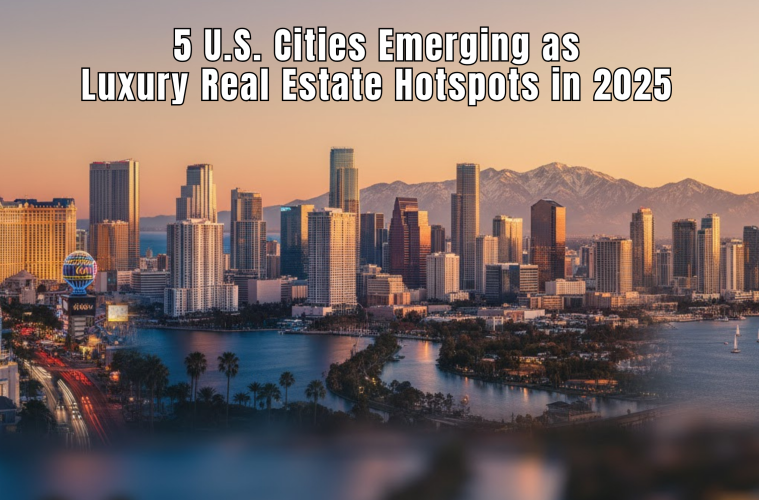
Where architecture, intention, and investment power the future of modern luxury.
Luxury real estate in 2025 has evolved beyond the era of oversized square footage and legacy penthouses. Today’s affluent buyer seeks depth, meaning, and multidimensional value. Prestige now includes tax efficiency, wellness architecture, cultural immersion, and the ability to place capital in resilient markets. High-net-worth investors are searching for cities where art, nature, infrastructure, and long-term appreciation intersect in intentional ways.
Across the United States, five cities have emerged as the new luxury frontier. These destinations blend economic intelligence with creative expression, reflecting a shift toward sophisticated living that is both financially strategic and emotionally enriching. From desert modernism and oceanfront skylines to tech-driven innovation hubs and nature-framed metros, these markets illustrate how luxury living and smart investment are becoming inseparable. Below, we explore the cities reshaping aspirational living and defining the future of high-end real estate in 2025.
1. Las Vegas, Nevada — The Desert Renaissance
Las Vegas is undergoing a profound reinvention that analysts refer to as The Desert Renaissance. Once defined primarily by entertainment, the city has transitioned into a global hub for sustainable luxury, design-forward development, and tax-advantaged wealth preservation. High-income buyers from California, New York, Illinois, Canada, and Asia are actively relocating capital into Nevada, where zero state income tax, favorable property tax structures, and strong appreciation rates support long-term investment performance. This migration has fueled a surge in demand for Nevada 1031 exchange properties, creating one of the most strategically advantageous environments for luxury buyers.
Within this transformation, hybrid luxury has emerged as one of the city’s strongest investment narratives. The Vdara Condos Las Vegas represent the pinnacle of this model, offering LEED Gold–certified construction, hotel-caliber service, panoramic views, and turnkey rental programs that regularly exceed 70 percent occupancy. Meanwhile, high-end neighborhoods such as The Ridges, Ascaya, and Summerlin West showcase a new architectural identity characterized by sculptural desert modernism, wellness amenities, canyon vistas, and integrated smart-home technology. Las Vegas is now a sophisticated, design-driven ecosystem where lifestyle elevation meets wealth optimization.
Las Vegas Market Highlights
- Median home price: approximately $465,000
- Cap rates typically range from 5.5 to 6.2 percent in luxury multifamily
- Population growth: 2.3 percent annually
- Zero state income tax and investor-friendly regulatory framework
- Short-term rental ecosystem remains one of the strongest in the western U.S.
2. Miami, Florida — The Global Magnet for Sunlit Sophistication
Miami has ascended into the top tier of global luxury cities, offering a rare intersection of architectural innovation, cultural diversity, and international liquidity. Its skyline, defined by avant-garde residential towers, reflects collaborations between world-renowned architects, luxury hospitality brands, and international design houses. Miami’s market strength is amplified by its role as the primary U.S. gateway for foreign investment. In 2024 alone, more than 25 million visitors and over $15 billion in global capital flowed into the Miami luxury sector, creating one of the most liquid and resilient real estate environments in the country.
At the center of this surge are branded residences including Waldorf Astoria Miami, Baccarat Residences, Aston Martin Tower, and Bentley Residences, each offering a mastery of sculptural form, light, materials, and curated lifestyle programming. These developments exemplify the experiential direction of modern luxury. Miami’s investor base—from South America, Canada, Europe, the Middle East, and East Asia—creates a continuous demand cycle that strengthens rental yields and long-term valuation. With a thriving tourism engine, international business hub, and lifestyle scene that blends art, gastronomy, and coastline, Miami remains one of the world’s most compelling luxury markets.
Miami Market Highlights
- Median condo price: about $520,000
- Luxury rental yields averaging 8 to 10 percent
- Approximately 60 percent of downtown inventory is investor-owned
- Annual tourism surpasses 25 million visitors
- More than $15 billion in foreign capital entered the market in 2024
3. Austin, Texas — The Tech Capital of Cool
Austin has transformed into a luxury epicenter shaped by innovation, creativity, and extraordinary economic expansion. Between 2019 and 2024, the city’s GDP surged by 52 percent, supported by major expansions from Tesla, Oracle, Apple, Google, and a robust venture capital community. Thousands of high-earning professionals continue to relocate annually, generating consistent demand for luxury estates, waterfront penthouses, and modern architectural homes. Austin’s ability to preserve its creative heritage—music festivals, murals, maker markets, and boutique districts—while becoming a trillion-dollar tech corridor is one of the most unique dualities in the luxury market today.
From biophilic design and minimalist glass towers to hilltop residences with panoramic views, Austin’s architecture reflects its fusion of creativity and sophistication. Investors have taken note. With no state income tax, strong job growth, vacancy rates under 6 percent, and a median home price around $540,000, the city offers long-term upside with cultural depth. Neighborhoods such as East Austin, South Congress, and Rainey Street have become the top targets for sophisticated investors using 1031 exchange strategies, drawn to their walkability, nightlife energy, and emerging luxury redevelopment.
Austin Market Highlights
- Median home price: approximately $540,000
- Job growth averages 4.2 percent annually
- Multifamily vacancy rate remains below 6 percent
- GDP increased by 52 percent between 2019 and 2024
- Texas imposes no state income tax
4. Denver, Colorado — Where Sustainability Meets Status
Denver has established itself as one of America’s most reliable luxury markets, offering a blend of economic resilience, outdoor access, and wellness-oriented architecture. The metro’s $240 billion GDP is anchored by aerospace, renewable energy, research institutions, healthcare innovation, and creative industries, creating a broad economic foundation that insulates the region from volatility. Luxury buyers gravitate toward Denver for its clean air, mountain proximity, and balanced pace of life. Architectural themes— natural stone, large-format glazing, solar integration, and indoor-outdoor transitions—reflect the city’s emphasis on wellness and environmental harmony.
Lifestyle-driven communities such as Cherry Creek North, RiNo, and LoHi have transformed into high-end neighborhoods featuring luxury boutiques, chef-driven restaurants, galleries, and curated cultural experiences. Investment performance reinforces Denver’s appeal: median home prices average $585,000, multifamily occupancy exceeds 95 percent, and cap rates trend between 4.6 and 5.8 percent. With median rents around $2,050 and steady population inflow, Denver offers predictable cash flow and appreciation. Its commitment to sustainable planning and LEED-certified construction makes it a model for long-term eco-luxury investment.
Denver Market Highlights
- Median home price: approximately $585,000
- Multifamily occupancy exceeding 95 percent
- Cap rates averaging 4.6 to 5.8 percent
- Median rent around $2,050
- Regional GDP approximately $240 billion
5. San Diego, California — The Soulful Coastline of the West
San Diego represents the most balanced and emotionally refined luxury market on the West Coast. Known for its year-round sunshine, calm coastal topography, and wellness-oriented community design, the city attracts affluent buyers seeking long-term stability and elevated living. With a regional GDP of $290 billion and thriving industries in biotech, life sciences, defense research, healthcare, and clean energy, San Diego maintains one of the most diversified economies in the state. These factors, combined with limited coastal supply, help preserve luxury property values even during market fluctuations.
Architecturally, San Diego’s luxury homes prioritize sun-filled interiors, seamless indoor-outdoor transitions, ocean-facing terraces, and climate-adaptive materials. Neighborhoods like La Jolla, Del Mar, Coronado, and Encinitas offer some of the most visually captivating homes in the western United States. With a median home price near $880,000, annual rent growth of about 6 percent, median incomes above $102,000, and 266 days of sunshine, San Diego appeals to buyers seeking both emotional clarity and financial consistency. It is a luxury market defined by natural calm, architectural restraint, and enduring desirability.
San Diego Market Highlights
- Median home price: approximately $880,000
- Median income around $102,000
- Rent growth averaging 6 percent annually
- Regional GDP near $290 billion
- Roughly 266 days of sunshine per year
The 2025 Luxury Investment Landscape
The luxury market in 2025 reflects a deeper evolution in buyer psychology. Affluent individuals are prioritizing intentional acquisitions—properties that combine financial strength, tax optimization, architectural innovation, and lifestyle authenticity. Nevada 1031 exchange properties have reshaped the national investment map by enabling buyers to transfer equity from high-tax states into appreciating, tax-neutral environments like Vdara Condos Las Vegas. Meanwhile, hybrid luxury models such as the Vdara Condos Las Vegas offer hotel-level living with flexible rental revenue, defining the next era of passive-income luxury.
Sustainability has become a baseline expectation, with ESG-focused construction, renewable energy integration, and wellness certifications influencing both demand and resale velocity. Experience-driven luxury is also gaining prominence. Miami’s cultural districts, Austin’s creative scenes, and Denver’s outdoor gateways are outperforming traditional luxury segments. Additional momentum comes from AI-enhanced investment tools that evaluate factors beyond price—such as walkability, climate resilience, transportation access, and cultural density—creating a more intelligent framework for luxury portfolio building.
Key Trends Shaping Luxury Real Estate
- Tax-efficient wealth strategies (notably Nevada 1031 exchange programs)
- Hybrid ownership models combining hospitality and passive income
- ESG and sustainable design influencing long-term value
- Experience-centric communities outperforming traditional enclaves
- AI-driven analysis refining luxury acquisition strategies
The Future of Refined Investing
Each of the five cities highlighted here represents a different dimension of the luxury evolution in 2025. Las Vegas illustrates how design-forward living and tax-free optimization can coexist. Miami demonstrates the power of global capital and architectural audacity. Austin blends creativity with technological acceleration. Denver embodies the union of sustainability, nature, and long-term reliability. San Diego offers coastal serenity paired with financial resilience.
These destinations are more than markets—they are movements. They shape how modern luxury buyers live, invest, and express their values through real estate. For those seeking intentional growth, diversified portfolios, and lifestyle elevation, this is a defining moment. Whether through Nevada 1031 exchange properties or hybrid residences like the Vdara Condos Las Vegas, today’s investors have the opportunity to align financial clarity with architectural meaning. In 2025, luxury is no longer defined solely by what you own— it is defined by the life you design through it.
Published by HOLR Magazine.