


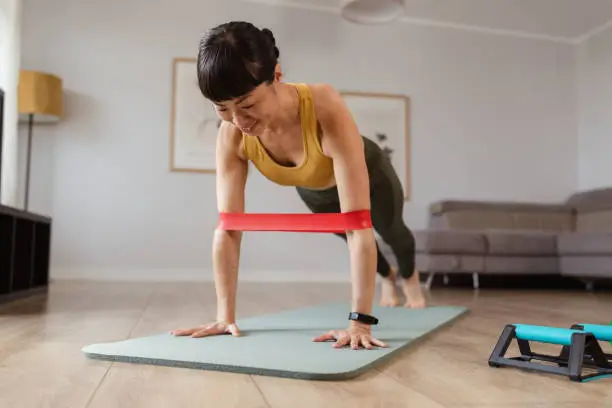
Resistance bands for glutes have gained tremendous popularity, and surprisingly, science confirms they actually work. Despite their simple appearance, these colorful elastic tools effectively build strength and muscle in your posterior chain. Short resistance bands, also known as mini bands or loop bands, create constant tension throughout each exercise. This continuous resistance forces your gluteal muscles to work harder than many traditional exercises. Additionally, bands improve muscle activation and mind-muscle connection, making them particularly effective for glute development.
What Makes Resistance Bands Effective for Glutes
The effectiveness of resistance bands for glutes comes from their unique physical properties and the way they engage muscles. In practical training, this is exactly the effect people look for when using tools like Tribe Lifting short resistance bands for legs, which are designed to maintain tension where free weights often fall short. Unlike traditional weights, bands create a distinct training stimulus by maintaining continuous tension throughout each movement.
While free weights lose resistance at certain points due to gravity, creating “resting points” where muscles disengage, resistance bands provide uninterrupted tension during both the concentric (shortening) and eccentric (lengthening) phases, allowing the glutes to stay engaged throughout the entire range of motion.
This constant tension keeps the glutes engaged for longer periods, building both strength and endurance. As the band stretches, resistance progressively increases, creating a challenge free weights can’t replicate. This variable resistance forces muscles to work hardest near the end range of motion–where many glute exercises reach peak activation.
The consistent elastic tension also recruits stabilizer muscles and keeps target muscles working longer, a factor linked to improved muscle definition. This makes bands especially effective for targeting all three glute muscles from multiple angles.
Why glute activation matters
Proper glute activation is essential for performance and injury prevention. Many people experience “sleeping glutes” due to prolonged sitting or overreliance on the quadriceps and hamstrings during lower-body movements.
Resistance bands are effective at reactivating these dormant muscles through targeted activation. Research shows banded exercises improve neuromuscular connection with the glutes, strengthening the mind-muscle connection and carrying over to other workouts.
Banded exercises help to:
- Activate and strengthen all three glute muscles, improving hip stability
- Reduce injury risk, particularly in athletes with hip stability challenges
- Enhance proprioception, increasing awareness of hip and knee positioning
- Improve coordination of supporting muscles, boosting performance in compound lifts
Overall, resistance band training helps prevent muscle imbalances that can lead to joint strain, inefficient movement patterns, and chronic discomfort.
The role of progressive overload with bands
Just like with weights, muscle growth (hypertrophy) with bands requires progressive overload–gradually increasing the challenge to stimulate adaptation. Research published in the Journal of Physiology shows that muscle growth depends not only on load but also on how long muscles remain under tension.
Resistance bands create ideal conditions for this tension-based growth. Their elastic nature keeps muscles working during both lifting and lowering phases, increasing time under tension. Slowing the tempo further enhances this effect–studies found that slower repetitions (around six seconds up and down versus one second) led to greater muscle development.
For continued progress, bands offer several progression options: increasing band resistance, adding repetitions, slowing tempo, or adjusting stance. This flexibility allows consistent challenge across fitness levels, making resistance bands effective for both beginners and advanced athletes aiming to build stronger, more defined glutes.
The Science Behind Glute Activation
To understand how resistance bands work for glute training, it helps to look at the muscles they target. The glutes are not just aesthetic – they are among the most powerful muscle groups in the body and play a central role in posture, movement, and athletic performance.
The gluteal region consists of three muscles with different functions. The gluteus maximus is the largest and strongest and is primarily responsible for hip extension during movements such as standing, running, and climbing. It tends to respond best when higher force demands are involved. A systematic review identifies the gluteus maximus as one of the primary hip extensors and reports very high activation levels (greater than 60% MVIC) in several hip-extension strength exercises, including the band hip thrust.
The gluteus medius supports hip abduction and pelvic stability during walking, with different fibers contributing to internal and external rotation. The smaller gluteus minimus works with the medius to stabilize the pelvis and support controlled hip movement. This is where resistance bands become especially useful.
Bands activate the glutes through constant tension across the full range of motion, eliminating resting points common with free weights and keeping muscles engaged longer. Band placement further affects activation – moving bands from the knees to the ankles or feet increases resistance demands and can shift emphasis toward specific glute muscles, including greater gluteus maximus involvement during squats. Bands also improve proprioception, strengthening the mind-muscle connection.
Research supports these effects. Studies on banded monster walks show progressive gluteus medius activation as bands move distally, while foot placement increases gluteus maximus activation. Other findings show that squats with bands around the forefeet increase glute activation without increasing compensatory muscle activity. Single-leg banded glute bridges have also demonstrated higher EMG activation in rehabilitation settings.
Overall, resistance bands are more than convenient alternatives to weights. By applying continuous tension and allowing precise targeting through band placement, they support stronger, more functional glutes in line with current exercise science.
Best Glute Band Exercises Backed by Research
Ready to put research into practice? These eight resistance band exercises effectively target all three gluteal muscles while delivering maximum results with minimal equipment.
- Glute bridge
The banded glute bridge targets the gluteus maximus, hamstrings, and lower back. Place a band above the knees, drive through the heels, and lift the hips until the body forms a straight line. Pressing the knees outward at the top increases glute activation.
- Lateral band walk
This exercise primarily targets the gluteus medius, which supports hip stability and knee alignment. Place the band above the ankles or knees and step sideways while maintaining tension and a partial squat. EMG studies show strong activation of the hip abductors.
- Clamshell
Clamshells activate the gluteus medius and minimus, both important for hip stability. Lie on your side with knees bent and lift the top knee without rotating the pelvis. Research identifies clamshells as effective for improving hip strength.
- Fire hydrant
Fire hydrants emphasize the gluteus medius. From a hands-and-knees position, lift one leg outward while keeping the knee bent. Adding a band increases activation of the lateral hip muscles.
- Hip thrust with abduction
This variation combines hip extension with band-resisted abduction. Adding a band around the thighs increases upper gluteus maximus activation compared to standard hip thrusts. Pressing the knees outward at the top enhances the effect.
- Squat with band
Banded squats improve glute engagement and help prevent knee collapse. Place a band above the knees and actively push outward during the squat. Studies show this variation significantly increases gluteus medius activation.
- Donkey kick
Donkey kicks primarily target the gluteus maximus. From an all-fours position, extend one leg back while keeping the knee bent. Using a band increases tension and improves isolation of the glutes.
- Monster walk
Monster walks involve diagonal forward steps under constant band tension. Band placement around the feet produces higher gluteus maximus activation than higher placements. This exercise is especially useful for improving hip stability.
Common Myths About Glute Bands Debunked
Despite growing popularity, misconceptions about resistance bands for glutes persist. Let’s examine what science actually tells us about these often underestimated training tools.
Myth: Bands are only for beginners
This is incorrect. While bands are accessible for beginners, advanced athletes also use them to improve performance, stability, and functional strength. Bands effectively target stabilizing muscles that traditional weights may miss.
Myth: You need heavy weights to grow glutes
Research challenges this idea. A 2019 meta-analysis found elastic band training can produce strength gains comparable to conventional resistance training when progressive overload is applied. Continuous tension and variable resistance make bands effective across the full range of motion.
Myth: Bands don’t build real muscle
Studies show resistance bands effectively stimulate muscle fibers. Meta-analyses report similar muscle activation with elastic resistance and traditional weights. Longer time under tension is a key reason bands support muscle growth.
Conclusion
Resistance bands have proven themselves far beyond mere workout accessories. Their unique ability to create constant tension throughout exercises makes them remarkably effective for developing stronger, more functional glutes. Scientific evidence clearly supports what many fitness enthusiasts have discovered through experience—these simple elastic tools activate gluteal muscles more effectively than many traditional exercises.
Published by HOLR Magazine.