


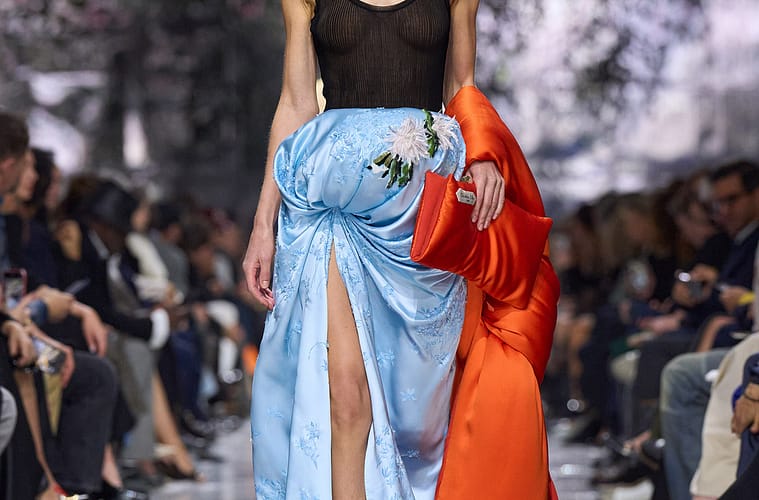
Dior Haute Couture 2026: Jonathan Anderson’s First Act
For his first couture collection at Dior, Jonathan Anderson did not aim to romanticize the house’s legacy—he examined it. Long associated with sculpted femininity, softened architecture, and the enduring symbolism of flowers, Dior has historically balanced beauty with control. Anderson’s debut sharpened that balance. Couture 2026 positioned florals not as decoration but as structure, rethinking Dior’s codes through an intellectual, architectural lens. It was a study in tension: between heritage and restraint, softness and rigor, romance and reason.
Florals as Architecture
Across these looks florals were treated not as embellishment but as engineered form. Petal-like surfaces were built outward with deliberate volume, creating sculptural silhouettes that held their shape independent of the body. Dresses curved, ballooned, or flared through internal structure rather than excess fabric, with layered elements carefully calibrated to achieve lift, tension, and balance. In darker iterations, florals appeared restrained and architectural, offsetting sharply tailored lines; in lighter looks, they expanded into rounded, almost cocooned forms that required precise weight distribution and expert handwork. The repetition of floral shapes—scaled up, compressed, or tightly clustered—revealed couture at its most exacting: nature abstracted into geometry, softness achieved through construction, and romance delivered through technique rather than decoration.

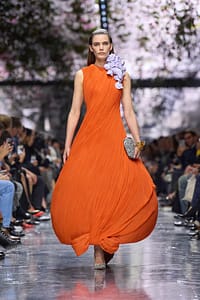

Bold Color Theory
Across these looks, color became one of the collection’s most assertive tools, signaling spring through confident contrast. Powder blues anchored the palette, offering calm and clarity, while vivid pinks—ranging from petal to saturated fuchsia—introduced energy and emotional lift. Orange cut through both, acting as a disruptive warmth that sharpened silhouettes and prevented the pastels from slipping into prettiness. Rather than blending harmoniously, the colors were deliberately stacked: cool against warm, delicate against bold. Blue grounded the body, pink animated the surface, orange punctuated the line. The effect was modern and intentional, using classic spring hues but refusing predictability. In each outfit, color functioned structurally, guiding the eye and reinforcing form—proof that at Dior, seasonal palettes can still feel disciplined, directional, and quietly radical.


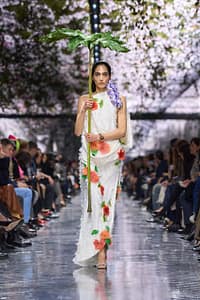
Architecture of Outerwear
At Dior, outerwear has always emphasized line and posture, and this collection sharpened that legacy rather than softened it. The coats hug the body with elongated proportions, then introduce subtle disruptions through controlled volume. Black dominated, reinforcing the coats’ architectural clarity, while curved seams and cocooned shapes introduced quiet complexity. These were not decorative pieces but structural ones: coats that framed the body with discipline, balancing Dior’s historic elegance with a modern sense of control and confidence.


The Intellectual Finale
The closing look distilled Anderson’s aesthetic most clearly. Elongated, minimal, and quietly commanding. It distilled everything Dior has historically stood for—discipline, proportion, and controlled femininity—into a single, resolved statement. Meticulous draping sculpted the bodice, drawing the fabric inward to a sharply cinched waist that recalled Dior’s foundational emphasis on structure and silhouette. From that anchor point, the skirt unfolded into a cascade of hand-applied petals. Each petal placed with technical precision to build volume without excess, creating movement while maintaining control. In closing the show this way, the gown reaffirmed Dior’s core language: elegance as the result of construction, restraint, and an unwavering commitment to form.

Dior Haute Couture S/S 2026
Dior Haute Couture Spring/Summer 2026 was not a reinvention, but a recalibration. In his first outing, Anderson didn’t soften the house—he clarified it. And in doing so, he set couture on a more rigorous, more deliberate path forward.