


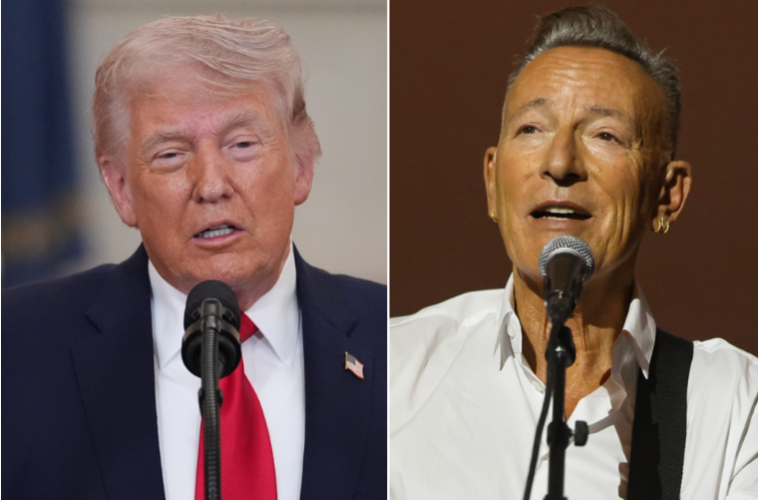
Political clash spills into music as rhetoric escalates
Donald Trump Targets Bruce Springsteen
April 02, 2026 – A new clash between politics and music has erupted after Donald Trump publicly called for a MAGA-led boycott of Bruce Springsteen’s tour, while also launching a series of personal attacks against the iconic musician. The remarks, which quickly gained traction online, mark an escalation in the long-standing tension between the two figures.
Trump reportedly criticized Springsteen not only for his political views but also with personal insults, calling him a “total loser” and making disparaging comments about his appearance. The rhetoric has sparked widespread debate, with reactions pouring in from both political supporters and music fans.

Image Credit: Andrew Harnik/Getty Images/Bruce Springsteen (Instagram)
A Longstanding Political Divide
The friction between Trump and Springsteen is not new. Springsteen has been openly critical of Trump’s leadership and political ideology for years, often using his platform to voice concerns about governance, social issues, and national direction.
Trump’s latest comments appear to be a direct response to Springsteen’s continued criticism, reflecting a broader pattern of public exchanges between political figures and cultural icons. These interactions often extend beyond policy disagreements into more personal territory.
Boycott Call and Its Implications
Trump’s call for a boycott of Springsteen’s tour introduces a new dimension to the conflict. Boycotts have long been used as a form of political expression, allowing supporters to align their consumer choices with their beliefs.
However, such calls can also deepen divisions, particularly when they target cultural events that traditionally bring diverse audiences together. In this case, the boycott appeal highlights how entertainment spaces are increasingly becoming arenas for political expression.

Image Credit: Getty Images
The Role of Celebrity in Political Discourse
Springsteen’s involvement in political conversations reflects a broader trend in which artists use their influence to engage with social and political issues. Known for his storytelling and connection to working-class themes, he has often positioned himself as a voice for certain values and perspectives.
This visibility, however, also makes him a target for criticism from those who disagree with his views. Trump’s remarks underscore how celebrity involvement in politics can invite both support and backlash.
Social Media Amplifies the Clash
As with many high-profile disputes, social media has played a central role in amplifying the situation. Clips, quotes, and commentary have spread rapidly, turning the exchange into a trending topic.
Supporters of Trump have echoed the boycott call, while Springsteen’s fans have rallied in defense of the musician. The digital response reflects the broader polarization that characterizes much of today’s public discourse.

Image Credit: Getty Images
Personal Attacks and Public Reaction
The personal nature of Trump’s comments has drawn particular attention. Critics argue that focusing on appearance detracts from substantive debate, while supporters view the remarks as part of his direct and unfiltered communication style.
The use of such language raises questions about the tone of political discourse and the boundaries of public criticism. It also highlights how quickly conversations can shift from policy to personality.
Music as a Cultural Battleground
The situation illustrates how music and entertainment have become intertwined with political identity. Concerts, tours, and public performances are no longer purely artistic spaces—they are also platforms where cultural and political values intersect.
Springsteen’s tour, which would typically be discussed in terms of music and performance, is now part of a larger conversation about ideology and public influence.
Industry and Fan Responses
While official responses from Springsteen’s team remain limited, fans and industry observers have been vocal. Many have dismissed the boycott call as unlikely to impact attendance, given Springsteen’s loyal fan base and longstanding reputation.
Others see the controversy as indicative of a broader shift, where even entertainment consumption becomes a reflection of political alignment.

Image Credit: Getty Images
Broader Implications for Public Figures
The clash between Trump and Springsteen highlights the challenges faced by public figures operating in highly polarized environments. Whether in politics or entertainment, individuals are increasingly navigating spaces where their actions and statements are subject to intense scrutiny and interpretation.
For both figures, the exchange reinforces their established public personas—Trump as a combative political figure and Springsteen as an outspoken cultural voice.
Final Thoughts
The latest confrontation between Donald Trump and Bruce Springsteen underscores the growing intersection of politics and entertainment. What began as a disagreement over views has evolved into a public spectacle involving boycott calls and personal attacks.
As audiences continue to engage with both figures, the situation serves as a reminder of how deeply intertwined cultural and political narratives have become. In today’s landscape, even a concert tour can become a focal point for broader societal tensions.
FAQs
Q1: Why did Donald Trump call for a boycott?
He criticized Bruce Springsteen’s political views and urged supporters to avoid his tour.
Q2: What did Trump say about Springsteen?
He made personal and political remarks, including calling him a “total loser.”
Q3: Has Bruce Springsteen responded?
There has been limited official response so far.
Q4: How are fans reacting?
Reactions are divided, with strong responses from both supporters and critics.
Q5: What does this controversy highlight?
It shows how politics and entertainment increasingly intersect in public discourse.
Published by HOLR Magazine