


Viral Fallon Interview Sparks Cultural Debate
Camila Morrone Criticized After The Tonight Show Starring Jimmy Fallon Appearance
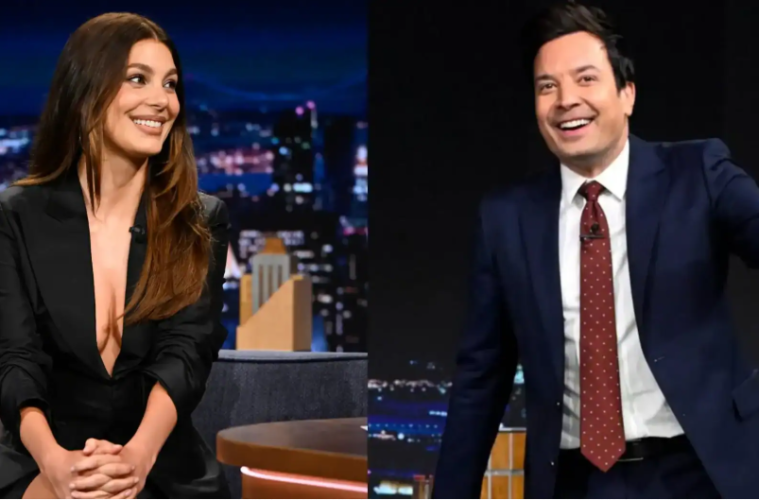
March 27, 2026 – Camila Morrone is facing online backlash after a lighthearted segment on The Tonight Show Starring Jimmy Fallon quickly turned into a viral controversy. During the interview, Morrone quizzed host Jimmy Fallon on what she described as “Toronto slang,” but viewers—particularly from Toronto—were quick to challenge the accuracy of the phrases.
The moment, intended as a fun cultural exchange, has since sparked a broader conversation about authenticity, cultural representation, and the influence of social media on language.

Image Credit: Getty images
What Happened on the Show
During her appearance, Morrone introduced Fallon to several phrases she claimed were commonly used in Toronto. She explained that she learned the slang from her co-star Adam DiMarco while filming a Netflix project.
The segment featured Morrone quizzing Fallon on phrases like “two-twos my word croski” and “that’s too mazza, ahlie,” offering multiple-choice meanings in a playful format.
While Fallon struggled to guess correctly, the studio audience responded with laughter—suggesting the segment achieved its entertainment goal. However, the reaction online told a different story.
“I’ve Never Heard of That” — Internet Reacts
Shortly after the clip aired, social media users began calling out the segment, with many claiming the slang presented was inaccurate or exaggerated.
Some Toronto-based viewers said they had “never heard” the phrases used in the way Morrone described, while others argued that the terms were misrepresented or incorrectly explained.
Criticism quickly spread across platforms like X and TikTok, where users debated whether the slang reflected real speech patterns or a distorted version influenced by internet culture.
The phrase “I’ve never heard of that” became a common reaction, encapsulating the skepticism surrounding the segment.

Image Credit: Getty Images
The Debate Over Authenticity
One of the central issues in the backlash is authenticity. Critics argue that the slang presented on the show does not accurately represent how people in Toronto speak on a day-to-day basis.
Some viewers described the phrases as “gentrified” or overly simplified, suggesting they were stripped of their original cultural context.
Others pointed out that while some of the expressions may exist, they are not as widely used or may have different meanings than those presented in the segment.
This debate highlights how regional language can be complex, evolving, and difficult to capture accurately—especially in a brief television segment.
Cultural Roots and Sensitivity Concerns
Beyond questions of accuracy, the controversy has also touched on deeper cultural issues. Linguists and social media users alike have noted that much of Toronto slang—often referred to as Multicultural Toronto English—has roots in Black and immigrant communities, including Caribbean, African, and Middle Eastern influences.
Some critics argued that presenting this language in a comedic context without acknowledging its origins risks reducing it to a stereotype or caricature.
This aspect of the backlash has shifted the conversation from simple inaccuracy to concerns about cultural appropriation and representation.
View this post on Instagram
A Divided Response Online
Despite the criticism, not all reactions have been negative. Some users defended Morrone, arguing that the slang she shared does reflect how certain groups—particularly younger generations—speak in parts of the Greater Toronto Area.
Others suggested that language is constantly evolving and that what may seem unfamiliar to some could be common in specific communities or online spaces.
This divide highlights how regional slang is not monolithic and can vary widely depending on age, location, and cultural background.
The Role of Social Media in Shaping Language
The controversy also underscores the role of social media in shaping and spreading language. Platforms like TikTok have played a significant role in popularizing certain slang terms, sometimes detaching them from their original context.
As a result, phrases can quickly gain global visibility—even if they are not widely used in their place of origin.
In Morrone’s case, it’s possible that the slang she learned reflects a mix of authentic expressions and internet-influenced variations.
Late-Night TV and Cultural Translation
Segments like the one on The Tonight Show are designed for entertainment, often simplifying complex topics for a broad audience. However, this approach can sometimes lead to misunderstandings or oversimplifications.
Translating regional culture into a short, humorous segment is inherently challenging, particularly when it involves language with deep cultural roots.
The backlash to Morrone’s appearance suggests that audiences are increasingly attentive to how culture is represented in mainstream media.

Image Credit: Getty Images
What This Means for Celebrity Appearances
The incident serves as a reminder that even lighthearted celebrity moments can carry unintended consequences. In an era where clips can go viral within minutes, public figures are under constant scrutiny—not just for what they say, but how it is interpreted.
For Morrone, the segment has become a talking point that extends far beyond its original intent.
It also reflects a broader shift in audience expectations, where authenticity and cultural awareness are increasingly valued.
Final Thoughts
What began as a playful late-night segment has evolved into a larger conversation about language, culture, and representation. Camila Morrone’s attempt to showcase Toronto slang may have been well-intentioned, but the reaction highlights how complex and sensitive cultural topics can be.
As audiences continue to engage with global content, moments like this underscore the importance of context and accuracy. Whether viewed as harmless fun or a misstep, the debate surrounding the segment reflects the evolving relationship between entertainment and cultural identity.
FAQs
Q1: Why is Camila Morrone being criticized?
She is being called out for teaching Jimmy Fallon Toronto slang that many say is inaccurate.
Q2: Where did this happen?
On The Tonight Show Starring Jimmy Fallon.
Q3: What phrases caused controversy?
Phrases like “two-twos my word croski” and “that’s too mazza, ahlie.”
Q4: Why is this considered sensitive?
Because Toronto slang has cultural roots tied to immigrant communities.
Q5: Did everyone disagree with her?
No, some people said the slang is used by certain groups, especially younger audiences.
Published by HOLR Magazine