


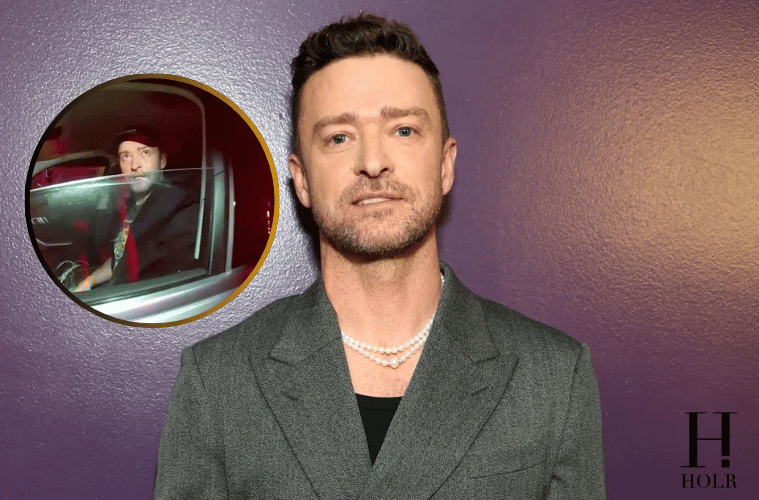
Justin Timberlake’s Bodycam Footage Reveals More Than an Arrest — It Exposes the Limits of Celebrity Control
March 21, 2026- The release of police bodycam footage from Justin Timberlake’s 2024 DWI arrest in Sag Harbor, New York, has quickly become one of the most discussed celebrity stories of the moment. While the footage itself captures a routine traffic stop escalating into an arrest, the broader implications extend far beyond a single incident.
🚨 BREAKING: Newly-released police body cam from Justin Timberlake’s DWI arrest in Sag Harbor, NY shows him struggling through field sobriety tests, and his friend playing the *NSYNC card. pic.twitter.com/HrEWCjZAKj
— TMZ (@TMZ) March 21, 2026
What emerges is not just a viral clip, but a layered narrative about celebrity identity, public accountability, and the growing inability of even the most carefully managed public figures to control their image in an era defined by constant visibility.
Inside the Traffic Stop: What the Footage Shows
The footage begins with officers stopping Timberlake after observing him allegedly run a stop sign and drift out of his lane. From the outset, the interaction appears relatively calm, but subtle details quickly begin to shift the tone.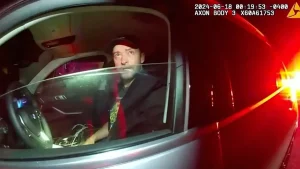
Timberlake identifies himself and mentions being on tour, an acknowledgment of his public identity that, while not unusual, introduces the dynamic of celebrity into an otherwise standard law enforcement situation. When asked about alcohol consumption, he states that he had consumed “one martini.”
As the interaction progresses, officers request that he perform field sobriety tests. It is here that the footage becomes more revealing. Timberlake appears visibly uncomfortable and tells officers that the tests are “really hard,” struggling with balance and coordination during the exercises.
He later refuses to take a breathalyzer test—a decision that carries legal consequences and often becomes a critical factor in DWI cases.
The ‘NSYNC Reference and the Question of Influence
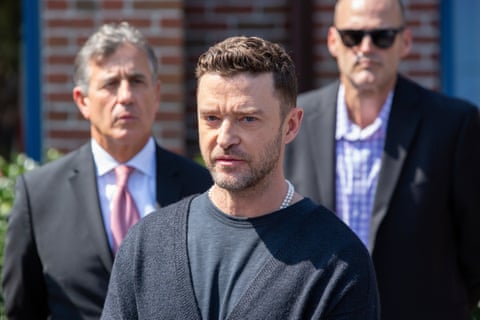
One of the most widely discussed moments from the footage involves a friend present at the scene, who attempts to intervene by referencing Timberlake’s music career—what many online have described as “playing the *NSYNC card.”
Photograph: Ted Shaffrey/AP
While the attempt may have been intended to de-escalate the situation, it ultimately had no impact on the officers’ actions. The arrest proceeded according to protocol, underscoring an important point: in that moment, recognition did not translate into exemption.
However, the significance of this moment lies less in its outcome and more in what it represents. It reflects a broader cultural assumption—that celebrity status can influence real-world consequences. The footage challenges that assumption, at least within the context of this encounter.
The Legal Timeline: From Arrest to Resolution
The arrest took place on June 18, 2024, in Sag Harbor, a location known for its high-profile summer residents. Following the incident, Timberlake faced charges related to driving while intoxicated, along with additional traffic violations.
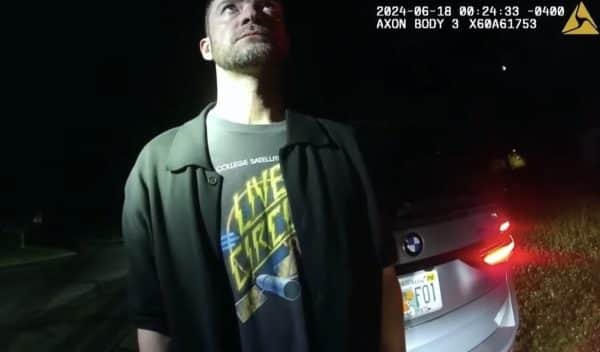
Image: TMZ
Over time, the case moved through the legal system, eventually resulting in a plea agreement. Timberlake pleaded guilty to a reduced charge of driving while impaired, avoiding a more severe conviction.
The outcome included:
- A financial penalty
- Community service requirements
- A temporary suspension of his driver’s license
He also participated in a public safety message addressing the dangers of impaired driving, signaling an effort to reframe the incident within a broader social context.
Why the Footage Was Released Two Years Later
Perhaps one of the most important aspects of this story is timing.
The footage was not released immediately after the arrest. Instead, it surfaced nearly two years later, following legal efforts to prevent its public disclosure. Timberlake’s legal team reportedly argued that the footage captured him in a vulnerable state and could unfairly shape public perception.
The eventual release—albeit in a redacted form—highlights the limits of such control. In today’s media environment, where public records and transparency laws intersect with digital distribution, delaying exposure does not necessarily prevent it.
Instead, it often intensifies interest.
A Different Kind of Exposure in the Digital Age
What distinguishes this incident from past celebrity controversies is the nature of the evidence. Unlike statements, interviews, or curated appearances, bodycam footage is inherently unfiltered. It presents events as they unfold, without the framing typically associated with public relations.

Getty
This creates a different type of engagement.
Audiences are no longer interpreting a narrative—they are witnessing it directly. Every gesture, pause, and reaction becomes part of the story, inviting scrutiny at a level that traditional media rarely achieves.
For celebrities, this represents a fundamental shift. Control over image is no longer absolute. Even the most carefully managed personas can be disrupted by a single, unscripted moment.
Public Image vs Human Reality
Justin Timberlake has long maintained a reputation built on professionalism and composure. From his early days in *NSYNC to his evolution as a solo artist and actor, his public image has been consistently polished.
The bodycam footage offers a stark contrast.
Instead of a performer in control of his environment, viewers see an individual navigating uncertainty, responding to authority, and grappling with a situation that cannot be rehearsed or edited.
This contrast is precisely what makes the footage compelling. It reveals the gap between public persona and private reality—a gap that audiences are increasingly interested in exploring.
Why This Story Resonates Now
The timing of the footage’s release is significant in another way. In 2026, public trust in celebrity narratives is more fragile than ever. Audiences are more skeptical, more analytical, and more attuned to inconsistencies between image and behavior.
Moments like this gain traction because they feel authentic.
They cut through layers of branding and present something that appears real, even if uncomfortable. In doing so, they align with a broader shift in media consumption—one that values transparency over perfection.
The Broader Conversation: Accountability in Public Life
At its core, this story is not just about Justin Timberlake. It is about how accountability functions when public figures are involved.
The footage demonstrates that:
- Legal processes remain structured and procedural
- Public visibility does not eliminate consequences
- Attempts to influence outcomes may not always succeed
At the same time, it raises questions about how such incidents are remembered. Is the defining narrative the arrest itself, the legal resolution, or the later release of footage?
In the digital age, all three coexist, shaping a more complex and enduring public record.
Conclusion
The release of Justin Timberlake’s bodycam footage transforms a past legal incident into a present-day cultural moment. It does more than document an arrest—it exposes the evolving relationship between celebrity, media, and public perception.
As audiences continue to engage with unfiltered content, the balance of control is shifting. What was once managed behind the scenes is now part of the public narrative, accessible and analyzable in real time.
In that sense, this story is not just about one individual. It reflects a broader reality: in today’s world, visibility is constant, and control is increasingly limited.
Published by HOLR Magazine