

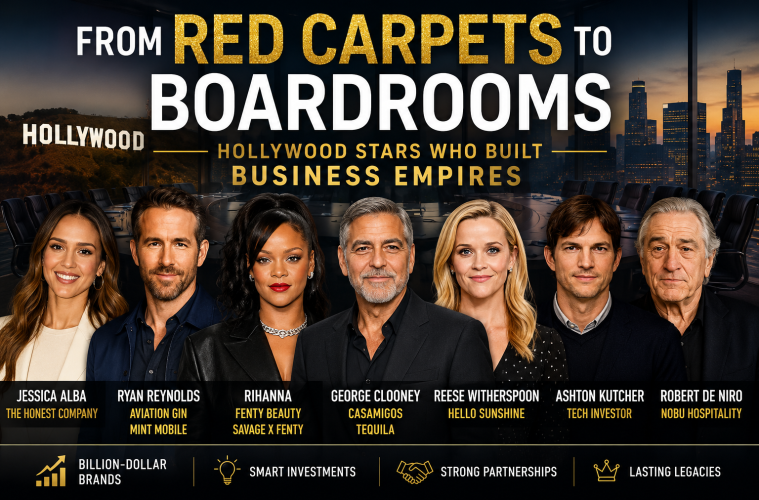
From Red Carpets to Boardrooms: Hollywood Stars Who Built Business Empires

July 20,2026: For generations, Hollywood represented the pinnacle of success. Landing a starring role in a blockbuster film or winning an Academy Award was considered the ultimate career achievement. But over the past two decades, something remarkable has happened. A growing number of actors and actresses have realized that fame can open doors—but it doesn’t guarantee long-term financial security.

Instead of relying solely on movie salaries, many of Hollywood’s biggest names have stepped into a completely different spotlight: entrepreneurship.

Some have launched beauty brands that changed entire industries. Others invested in technology before Silicon Valley’s biggest companies became household names. A few transformed simple personal ideas into billion-dollar businesses, proving they were just as comfortable in boardrooms as they were on movie sets.

Their journeys aren’t simply about making more money. They reveal how creativity, resilience, and smart decision-making can help build lasting businesses that continue growing long after the credits roll.

HOLR explores the Hollywood stars who successfully reinvented themselves as entrepreneurs—and the lessons their stories offer anyone dreaming of building something beyond their first career.

The Honest Company hosted a conversation with Founder Jessica Alba and First Lady of Los Angeles, Amy Elaine Wakeland, for the Getty House Foundation Women's Leadership Series. Following, Mayor Eric Garcetti welcomed The Honest Company with co-founders Jessica Alba and Sean Kane to Los Angeles with a special ribbon cutting ceremony and proclamation on March 30, 2016 in Beverly Hills, California.

Image Credit: WireImage

Jessica Alba: Turning a Mother’s Concern Into a Public Company

When Jessica Alba announced she was launching The Honest Company in 2011, many people assumed it would be another celebrity-backed product line that would disappear after a few years.

Instead, she surprised almost everyone.

The idea for the business wasn’t inspired by Hollywood. It came from a deeply personal experience. After becoming a mother, Alba struggled to find household and baby products she felt comfortable using around her family. Having dealt with allergies and health issues throughout childhood, she wanted products made with greater transparency about ingredients.

Rather than waiting for major companies to change, she decided to create a business that reflected her own values.

That decision transformed her career.

The Honest Company quickly expanded from baby products into beauty, skincare, and household essentials. Its emphasis on cleaner ingredients and accessible wellness resonated with millions of consumers at a time when demand for healthier lifestyle products was rapidly growing.

In 2021, the company reached another milestone by becoming publicly traded on the NASDAQ.

For Jessica Alba, the achievement wasn’t simply financial. It proved that celebrities could build businesses based on genuine purpose rather than relying solely on their fame.

Image Credit: Getty

Ryan Reynolds: The Actor Who Made Advertising Entertaining Again

Ryan Reynolds is known for his quick wit on screen, but his greatest business talent may be his understanding of modern marketing.

Instead of creating traditional advertisements, Reynolds turned advertising itself into entertainment.

Whether promoting Aviation American Gin, Mint Mobile, or his creative agency Maximum Effort, he consistently produced campaigns filled with humour, self-awareness, and storytelling.

People didn’t skip his commercials.

They shared them.

That simple difference changed everything.

His marketing strategy made consumers feel connected to the brand rather than sold to by it.

The results were extraordinary.

Aviation Gin was later acquired by beverage giant Diageo in a deal worth up to $610 million, while Mint Mobile was sold to T-Mobile in a transaction valued at approximately $1.35 billion.

Although Reynolds owned only portions of those businesses, the deals established him as one of Hollywood’s most respected entrepreneurs.

His success offers an important reminder that in today’s digital world, people often connect with authenticity more than polished advertising campaigns.

George Clooney: How a Casual Idea Became a Billion-Dollar Brand

George Clooney never planned to build one of the most successful celebrity businesses in history.

The story behind Casamigos Tequila began with something surprisingly ordinary.

While spending time in Mexico with longtime friends Rande Gerber and Mike Meldman, they searched for a tequila they genuinely enjoyed drinking. Unable to find exactly what they wanted, they worked with a local distillery to create one for themselves.

Initially, they had no intention of selling it commercially.

Friends who tasted the tequila encouraged them to consider bringing it to market.

That small idea quickly evolved into one of the spirits industry’s biggest success stories.

Unlike many celebrity liquor brands, Casamigos wasn’t built around flashy marketing. The founders focused on creating a smooth, approachable tequila while allowing the brand’s authenticity to speak for itself.

Only four years after launching, beverage company Diageo purchased Casamigos in a deal reportedly worth up to $1 billion.

The acquisition reshaped Hollywood’s view of celebrity entrepreneurship.

It demonstrated that actors didn’t have to depend on film salaries forever. With the right idea, careful branding, and patience, they could build businesses that rivaled—or even surpassed—their entertainment careers.

For Clooney, Casamigos wasn’t simply a business success.

It became proof that some of the best entrepreneurial ideas begin with solving a personal need rather than chasing the next big trend.

Fenty By Rihanna Launch

Image Credit: WireImage

Reese Witherspoon: Building a Business Around Better Stories

By the time Reese Witherspoon founded Hello Sunshine in 2016, she had already established herself as one of Hollywood’s most respected actresses. But despite her success, she often spoke about one frustration—there weren’t enough meaningful stories centered on women.

Instead of waiting for studios to create those opportunities, she built a company that would.

Hello Sunshine wasn’t designed to be another production house. Its mission was clear from the beginning: tell stories that celebrate women’s experiences through television, film, podcasts, books, and digital content.

The strategy paid off.

Projects like Big Little Lies, Little Fires Everywhere, The Morning Show, and Where the Crawdads Sing became both critical and commercial successes. More importantly, they demonstrated that audiences were eager for character-driven stories led by complex female protagonists.

In 2021, Hello Sunshine was sold in a deal valued at around $900 million.

Witherspoon’s entrepreneurial journey shows that business isn’t always about launching a physical product. Sometimes, the biggest opportunity lies in recognizing what an industry is missing and creating it yourself.

Rihanna Didn’t Follow the Beauty Industry—She Changed It

When Rihanna launched Fenty Beauty in 2017, celebrity beauty brands were already becoming popular. But instead of entering an already crowded market with another makeup collection, she focused on something the industry had overlooked for years.

Inclusion.

Fenty Beauty debuted with 40 foundation shades, offering significantly more options than many established beauty brands at the time. Customers with lighter, deeper, and often underserved skin tones finally found products that reflected their needs.

The response was immediate.

Products sold out within days, beauty influencers praised the brand’s inclusivity, and competitors began expanding their own shade ranges. Industry analysts later referred to this shift as the “Fenty Effect,” acknowledging the influence Rihanna had on changing beauty standards worldwide.

Her success didn’t stop there.

She later expanded into lingerie with Savage X Fenty, another brand built around diversity and body positivity rather than traditional fashion norms.

Rihanna’s business philosophy highlights an important lesson: companies that genuinely listen to consumers often outperform those simply following trends.

Selena Gomez Rare Beauty

Image Credit: Rare Beauty

Selena Gomez Built a Brand With Purpose

Many celebrity beauty brands focus on glamour.

Selena Gomez chose something different.

When she introduced Rare Beauty, she made it clear that the company wasn’t about chasing perfection. Instead, it encouraged people to embrace individuality and feel comfortable in their own skin.

That message reflected Gomez’s own experiences.

Over the years, she has openly discussed living with lupus, undergoing a kidney transplant, and managing her mental health. Rather than hiding those challenges, she used them to create a brand centered on authenticity.

Rare Beauty also launched the Rare Impact Fund, supporting mental health initiatives and aiming to increase access to mental health resources worldwide.

Consumers connected with that honesty.

The company became one of the fastest-growing celebrity beauty brands because customers believed in the mission behind the products—not just the celebrity behind the logo.

Ashton Kutcher Quietly Became One of Silicon Valley’s Most Successful Investors

While many actors launched fashion labels or beverage companies, Ashton Kutcher took an entirely different path.

He invested in technology.

Years before companies like Uber, Airbnb, Spotify, Pinterest, and Duolingo became household names, Kutcher recognized their potential and invested through firms including A-Grade Investments and Sound Ventures.

His success wasn’t built on celebrity appearances.

It came from spending time with founders, learning about technology, studying business models, and understanding long-term market trends.

Today, many entrepreneurs know him less as an actor and more as a serious venture capitalist.

His career proves that entrepreneurship isn’t always about creating a business from scratch. Sometimes, it’s about identifying the right ideas before everyone else sees their value.

Robert De Niro Helped Create a Global Hospitality Brand

Robert De Niro’s business journey looks very different from many of his Hollywood peers.

Instead of entering beauty, fashion, or technology, he invested in hospitality.

Together with celebrated chef Nobu Matsuhisa and producer Meir Teper, De Niro co-founded Nobu Hospitality.

What began as a single restaurant in New York City has grown into an internationally recognized brand featuring luxury restaurants, hotels, and residences across North America, Europe, Asia, the Middle East, and Australia.

Nobu’s success wasn’t built on celebrity appearances.

Customers returned because of exceptional dining experiences, consistent quality, and a reputation for excellence.

That’s one reason the brand continues to thrive decades after opening its first restaurant.

What These Hollywood Entrepreneurs Have in Common

Looking at these stories, it’s tempting to assume their fame guaranteed success.

The truth is far more interesting.

Each celebrity entered an industry filled with experienced competitors. Fame may have attracted initial attention, but it couldn’t build customer loyalty.

Their businesses succeeded because they shared several important qualities.

They identified genuine market gaps instead of chasing short-lived trends.

They surrounded themselves with experienced partners who understood business operations.

They invested time in learning about their industries rather than simply licensing their names.

Most importantly, they built companies with long-term vision instead of focusing on quick profits.

Jessica Alba solved a personal problem.

Ryan Reynolds reinvented marketing through storytelling.

George Clooney built an authentic lifestyle brand.

Reese Witherspoon changed entertainment.

Rihanna challenged beauty standards.

Selena Gomez created purpose-driven products.

Ashton Kutcher invested in innovation.

Robert De Niro focused on memorable customer experiences.

Different industries.

Different strategies.

The same entrepreneurial mindset.

Final Thoughts

Hollywood may introduce celebrities to the world, but business tests an entirely different set of skills.

It demands patience, resilience, curiosity, adaptability, and the ability to earn consumers’ trust—qualities that can’t be learned on a film set alone.

The celebrities featured here didn’t succeed because they were famous.

They succeeded because they recognized opportunities, listened to consumers, worked alongside experienced professionals, and remained committed to building businesses with lasting value.

Their stories also reflect a larger shift happening across entertainment.

Today’s celebrities are no longer satisfied with simply endorsing products.

They want ownership.

They want creative control.

And they want to build companies capable of making an impact long after their acting careers evolve.

For aspiring entrepreneurs, that’s perhaps the biggest lesson of all.

Success isn’t about having the loudest voice or the biggest audience.

It’s about solving real problems, creating something people genuinely value, and staying committed long after the excitement of a launch fades.

The red carpet may introduce the world to a celebrity.

But it’s often the boardroom where their most enduring legacy is built.

FAQs

Which Hollywood stars have built successful business empires?

Several Hollywood celebrities have successfully expanded beyond acting into business. Notable examples include Jessica Alba with The Honest Company, Ryan Reynolds with Aviation Gin and Mint Mobile, George Clooney with Casamigos Tequila, Reese Witherspoon with Hello Sunshine, Rihanna with Fenty Beauty, Selena Gomez with Rare Beauty, Ashton Kutcher through tech investments, and Robert De Niro with Nobu Hospitality.

Why are so many Hollywood celebrities becoming entrepreneurs?

Many celebrities are building businesses to create long-term financial stability, diversify their careers, and have greater creative control. Rather than relying solely on acting roles, they are investing in industries they are passionate about and creating brands that can continue growing for years.

Which celebrity business has been the most successful?

Several celebrity-founded businesses have achieved remarkable success. George Clooney’s Casamigos Tequila sold in a deal worth up to $1 billion, while Rihanna’s Fenty Beauty has become one of the world’s leading beauty brands. Ryan Reynolds has also seen major success through Aviation Gin and Mint Mobile.

What are the biggest stories trending online today? Read the latest here

Published by HOLR Magazine

Image Credit: AI