


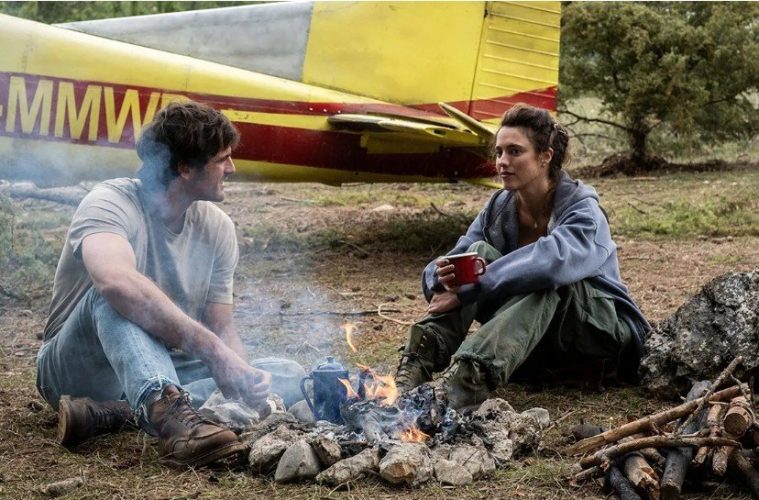
Jacob Elordi, Margaret Qualley and Josh Brolin lead Ridley Scott’s subdued post-apocalyptic drama, a film more interested in grief and human connection than spectacle.
A Quieter Kind of Post-Apocalyptic Movie
August 26, 2026 – Ridley Scott’s The Dog Stars takes place after a devastating flu pandemic has wiped out most of the population. Based on Peter Heller’s 2012 novel, the film follows a small group of survivors trying to build lives in a world where civilization has largely disappeared.
That setup could easily lead to another action-heavy survival thriller, but Scott takes a quieter route. The film spends more time with loneliness, grief and the difficulty of finding reasons to keep going than with large-scale destruction.
That restraint gives The Dog Stars an unexpectedly soulful quality, even when the story occasionally struggles to maintain its balance between intimate drama and familiar post-apocalyptic action.
Credit: 20th Century Studios
Jacob Elordi Plays a Survivor Looking for More
Elordi plays Hig, a mechanic and former pilot living at a remote Colorado airstrip with his loyal dog, Jasper, and Bangley, a hardened former military man played by Josh Brolin.
The two men have very different ideas about survival. Bangley approaches the collapsed world with suspicion and military discipline, convinced that strangers represent a threat. Hig, meanwhile, remains haunted by the people he has lost and continues looking for evidence that something resembling a human community might still exist.
Elordi keeps Hig deliberately restrained. His performance is built around quiet sadness rather than dramatic speeches, making the character feel more like someone enduring grief than someone actively overcoming it.
That low-key approach suits the movie’s atmosphere, although it can also make the story feel slow when the surrounding material fails to provide enough tension.
Jasper Is More Than a Sidekick
Jasper, Hig’s dog, is one of the movie’s most important characters despite having no dialogue. His presence gives Hig companionship in an otherwise nearly empty world and provides an emotional connection that does not require explanation.
The relationship also helps explain why Hig has not completely surrendered to the harsh logic of survival. He still cares for another living creature, still seeks beauty and still responds to moments of tenderness.
Those quieter details are where the film often works best. Rather than emphasizing how difficult it is to survive, Scott is more interested in what makes survival worthwhile.
Margaret Qualley Brings Another Kind of Hope
Hig’s search eventually leads him to Cima, played by Margaret Qualley, and her father, Pops, played by Guy Pearce. Like Hig, Cima has experienced profound loss, giving the two characters an immediate emotional connection.
Their relationship develops gradually rather than through the kind of instant romance common in genre films. Both characters are carrying grief, and their attraction is presented as a tentative rediscovery of intimacy.
Qualley brings a guarded quality to Cima that complements Elordi’s quieter performance. Their scenes are strongest when the movie allows them simply to spend time together rather than forcing the relationship into a conventional romantic storyline.
Josh Brolin Provides the Energy
Brolin’s Bangley gives the film some much-needed contrast. Where Hig remains introspective, Bangley is blunt, suspicious and occasionally funny.
Their relationship is one of the movie’s more enjoyable elements because the men disagree about almost everything while still relying heavily on one another. Brolin gives Bangley a sharper personality, preventing the character from becoming simply another grim survivalist.
The dynamic also creates an interesting question at the center of the film: is surviving enough, or does a meaningful life require trust and connection with other people?
The World Looks Beautifully Empty
Scott and cinematographer Erik Messerschmidt give the ruined world a striking visual identity. The film was shot in northern Italy, with the landscape standing in for Colorado, and the mountains and forests create an enormous sense of isolation.
The cinematography favors muted tones rather than the bright, spectacular imagery often associated with large-scale science fiction. That choice reinforces the story’s melancholy mood.
There are still moments of action, but the visual emphasis remains on empty landscapes and small groups of people moving through them. The setting feels less like a playground for action and more like a physical representation of the characters’ loneliness.
The Familiar Parts Are Less Successful
The film becomes less effective when it moves into standard post-apocalyptic territory. Roaming groups of violent scavengers appear, creating straightforward threats for Hig and the others.
Those sequences feel much more familiar than the film’s quieter character work. The antagonists are less interesting than the survivors, and the story sometimes seems to introduce danger because the genre requires it rather than because the characters’ development naturally leads there.
One major sequence involving Allison Janney also feels disconnected from the more intimate tone established elsewhere.
The result is an uneven film. Its strongest material is about people trying to recover their humanity, while its weaker sections resemble the very survival thriller the movie otherwise seems determined to avoid.

Credit: 20th Century Studios
Scott Is More Interested in Connection Than Destruction
The biggest surprise is how little The Dog Stars depends on spectacle. Scott is one of cinema’s most accomplished visual filmmakers, yet much of the film’s emotional weight comes from conversations, quiet landscapes and small gestures.
That approach will not satisfy viewers expecting a relentless action movie. But it gives the story a different purpose. The real enemy is not always the people threatening Hig’s home; it is the possibility that grief and fear could convince survivors that there is no reason to rebuild anything.
In that sense, the title becomes more meaningful. The dog, the landscape, music and new relationships all become reminders that beauty and attachment can survive even after society has collapsed.
A Mixed but Appealing Experiment
The Dog Stars does not completely escape the clichés of the genre, and its slower pace will test some audiences. The screenplay occasionally leans too heavily on familiar threats, while some supporting characters are less developed than the central group.
But Scott’s decision to emphasize tenderness gives the movie an identity. Elordi and Qualley find believable vulnerability in their characters, Brolin brings personality and humor, and the film’s canine companion provides a surprisingly strong emotional anchor.
It is not Scott’s most inventive science-fiction film, but it is more reflective than its premise suggests.
Final Verdict
The Dog Stars works best when it slows down. Its strongest moments are not the firefights or survival sequences but the scenes in which damaged people begin imagining a future beyond simply staying alive.
Jacob Elordi gives Hig an understated sadness, Margaret Qualley provides warmth without sentimentality, and Josh Brolin brings welcome energy to an otherwise subdued film.
The movie may not reinvent post-apocalyptic cinema, but it finds something worthwhile inside a familiar setting: the idea that survival means very little without someone, or something, worth surviving for.
FAQs
What is The Dog Stars about?
The film follows Hig, a pilot and mechanic living after a devastating flu pandemic has destroyed most of society. He lives with his dog Jasper and survivalist Bangley before encountering other survivors who change his understanding of what life after the collapse could mean.
Who stars in The Dog Stars?
Jacob Elordi, Margaret Qualley, Josh Brolin and Guy Pearce lead the film. Allison Janney and Benedict Wong also appear.
Who directed The Dog Stars?
Ridley Scott directed the film from a screenplay by Mark L. Smith, based on Peter Heller’s novel.
Is The Dog Stars an action movie?
It contains action and survival elements, but the film is primarily a character-driven post-apocalyptic drama focused on grief, isolation and human connection.
When is The Dog Stars released?
The film is scheduled to open in U.S. and U.K. theaters on August 28, 2026.
Published by HOLR Magazine