


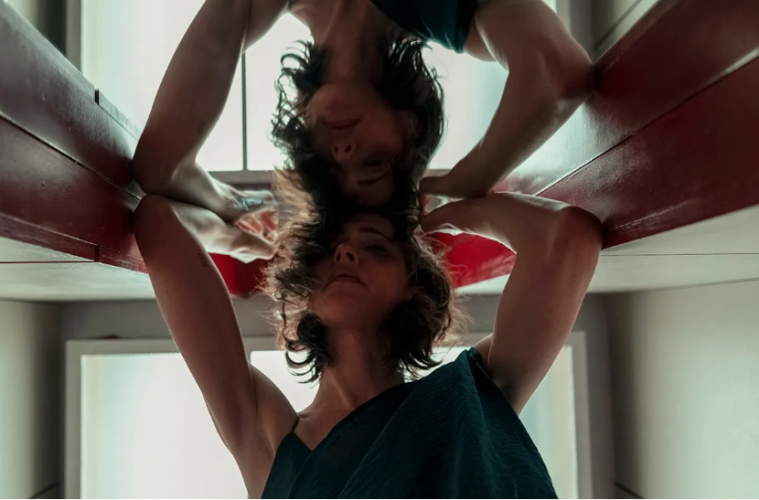
Rebecca Hall and Gael García Bernal lead an emotionally strange apocalypse story
‘The End of It’ approaches sci-fi through emotion
May 25, 2026 – The End of It attempts to explore the apocalypse through emotional discomfort, fractured relationships, and existential uncertainty rather than traditional blockbuster spectacle.
Starring Rebecca Hall, Gael García Bernal, and Beanie Feldstein, the film follows a group of emotionally disconnected characters trying to navigate personal fears and unresolved tensions while society edges toward collapse.
Instead of leaning heavily into large-scale destruction or action sequences, the movie remains focused on quieter emotional moments, awkward conversations, and surreal interpersonal tension.
That creative direction gives the film a distinct identity compared to more conventional science-fiction releases currently dominating theaters and streaming platforms.
At the same time, the unusual pacing and emotionally messy storytelling style may divide viewers expecting a more straightforward narrative structure.

Credit: Andres Arochi/Nino Muñoz/Heather Hazzan/Lenita Visan
Rebecca Hall delivers the film’s strongest performance
Rebecca Hall once again proves herself one of modern cinema’s most reliable dramatic performers.
Her performance becomes the emotional center holding the movie together during moments where the storytelling intentionally drifts into ambiguity and discomfort.
Hall brings vulnerability, emotional exhaustion, and quiet intelligence to a character constantly trying to maintain composure while internally unraveling.
Even when scenes become overly abstract or emotionally repetitive, she consistently grounds the material in something believable and human.
The actress has built a career excelling in emotionally layered independent films, and The End of It continues that pattern strongly.
Much of the movie’s emotional weight depends entirely on Hall’s ability to make fragmented emotional scenes feel authentic instead of performative.
Fortunately, she succeeds at that challenge throughout most of the runtime.
Gael García Bernal and Beanie Feldstein provide balance
Gael García Bernal brings warmth and subtle emotional unpredictability to the film.
His performance adds humanity to a story that occasionally risks becoming emotionally cold due to its detached atmosphere and slow pacing.
Bernal shares strong chemistry with Hall, particularly during quieter scenes focused on emotional vulnerability rather than sci-fi concepts.
Meanwhile, Beanie Feldstein contributes much of the movie’s intentionally awkward comedic energy.
Her nervous humor and emotionally chaotic reactions help create moments of levity without fully disrupting the heavier emotional tone.
Although portions of the humor feel uneven, Feldstein’s sincerity keeps the character engaging.
Together, the supporting performances help prevent the film from collapsing completely under the weight of its own existential seriousness.

Credit: Frederic J. Brown/AFP
The movie embraces ambiguity over clear answers
One of the film’s biggest creative strengths is also its most frustrating quality.
The End of It deliberately avoids explaining every aspect of its sci-fi premise clearly, choosing instead to focus on emotional atmosphere and psychological tension.
The apocalypse itself often feels secondary to the emotional collapse happening within the characters.
For viewers who enjoy emotionally driven and interpretive science fiction, that ambiguity may feel refreshing and artistically confident.
Others, however, may struggle with the lack of narrative clarity and traditional momentum.
Several scenes prioritize mood, silence, and emotional discomfort over actual plot progression.
The movie often behaves more like an emotional character study wrapped inside a science-fiction setting than a traditional genre film.
That artistic choice ultimately determines whether viewers connect with the experience or become frustrated by it.
Pacing problems begin hurting the second half
Despite strong performances and an intriguing atmosphere, the film begins losing momentum during its later sections.
The second half especially suffers from repetitive emotional conversations and scenes that stretch slightly longer than necessary.
Several themes surrounding loneliness, fear, emotional repression, and human connection repeat themselves multiple times without adding enough new insight.
A tighter runtime likely would have strengthened the movie considerably.
Still, even during slower stretches, the performances remain compelling enough to sustain audience interest.
The emotional realism and awkward interpersonal dynamics continue feeling authentic even when the overall story drifts narratively.
Viewers willing to engage patiently with slower and more introspective storytelling may find the film rewarding despite its structural flaws.
View this post on Instagram
The emotional discomfort feels intentionally realistic
What makes The End of It memorable is how intentionally uncomfortable it feels emotionally.
Characters frequently avoid direct honesty, misunderstand one another, or spiral into strange emotional interactions reflecting broader anxieties about mortality and isolation.
That awkwardness creates moments that feel surprisingly real despite the unusual sci-fi framework surrounding them.
Rather than glamorizing apocalypse scenarios, the movie presents emotional confusion and instability as deeply human responses to uncertainty.
The film’s strongest scenes are often its quietest — moments where characters struggle to communicate feelings they barely understand themselves.
That emotional realism helps separate the movie from more formulaic science-fiction storytelling.
The film will likely divide sci-fi audiences
Audience reactions to The End of It will likely depend heavily on personal expectations surrounding science fiction itself.
Viewers hoping for action, spectacle, or tightly structured storytelling may find the film frustratingly slow and emotionally abstract.
Meanwhile, audiences drawn toward introspective, emotionally driven genre films may appreciate its willingness to experiment with tone and structure.
The movie clearly prioritizes atmosphere, vulnerability, and emotional tension over traditional entertainment pacing.
That approach makes the experience feel distinctive even when imperfect.

Credit: Michael Loccisano/WireImage
Final Thoughts
The End of It does not fully succeed in balancing all of its ambitious emotional and science-fiction ideas, but the film remains compelling because of its performances, atmosphere, and emotional honesty. Rebecca Hall, Gael García Bernal, and Beanie Feldstein each bring vulnerability and humanity to a story more interested in emotional survival than blockbuster spectacle. While the pacing becomes uneven during the second half, the movie still stands out as a strange, thoughtful, and emotionally uncomfortable sci-fi experience that lingers long after the credits end.
FAQs
Q1. Who stars in The End of It?
The film stars Rebecca Hall, Gael García Bernal, and Beanie Feldstein.
Q2. What genre is the movie?
It blends science fiction, emotional drama, and dark comedy.
Q3. What is the film mainly about?
The story explores emotional relationships and personal anxiety during an approaching apocalypse.
Q4. What criticism has the movie received?
Some viewers and critics feel the runtime and pacing become overstretched.
Q5. Why is the movie considered unusual?
It focuses more on emotional atmosphere and awkward human behavior than traditional sci-fi action.
Published by HOLR Magazine