


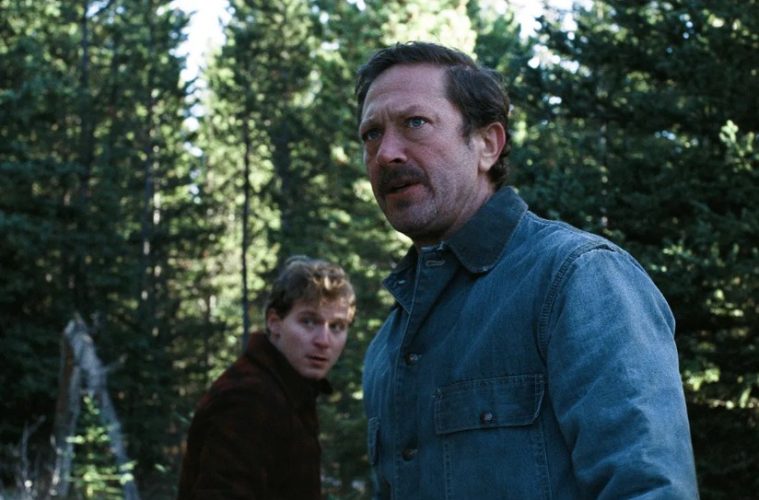
Andrew Haigh’s restrained mountain drama follows a family unraveling in the Rockies, with Fred Hechinger and Ebon Moss-Bachrach at its core.
September 5, 2026
A Family Caught Between Isolation and Change
Andrew Haigh’s A Long Winter is the kind of drama that builds its emotional weight quietly. Set in the Colorado Rockies during the early 1950s, the film follows a family living in profound physical and emotional isolation as the arrival of winter threatens to expose tensions that have been simmering beneath the surface.
At the center is Mike, played by Fred Hechinger, a young man whose relatively sheltered understanding of his family begins to fracture. His older brother Tommy, portrayed by Kit Connor, leaves to fight in the Korean War, while his mother Louise, played by Caitríona Balfe, grows increasingly unhappy with the life she shares with her husband Lester, played by Ebon Moss-Bachrach. When Louise disappears, Mike and Lester are left facing not only the harsh landscape around them but also the emotional damage inside their home.
Credit: Mubi
Fred Hechinger Carries the Emotional Center
Hechinger gives the film its most important perspective. Mike is not simply watching his family fall apart; he is slowly realizing that the adults around him have complicated histories, frustrations and desires that he has never fully understood.
What makes the performance effective is its restraint. Rather than turning Mike’s development into a series of dramatic declarations, Hechinger lets the character change through observation. His shifting reactions, discomfort and growing awareness gradually reveal a young man being forced to see his family and himself more honestly.
Ebon Moss-Bachrach Brings Complexity to Lester
Moss-Bachrach plays Lester as a man whose hardness is inseparable from his pain. He is not presented as a straightforward villain or an easy victim, and that ambiguity gives the family conflict much of its power.
The actor brings a physical heaviness to the role that fits the film’s setting. Lester belongs to a harsh world where survival depends on routine, labor and endurance, yet the disappearance of his wife forces him into an emotional crisis that those habits cannot easily solve.
The Landscape Becomes a Character
The Rockies are more than a backdrop in A Long Winter. The enormous landscape makes the family feel small, while the isolation of their home intensifies every disagreement and every silence.
Much of the film was shot in Alberta, Canada, standing in for the Colorado setting. The production built the family’s mountain home on location, allowing the environment to remain an active part of the filmmaking rather than something added around the characters later. The result is a physical sense of cold, distance and vulnerability that suits Haigh’s intimate approach.
Andrew Haigh Keeps the Drama Understated
Haigh has built a reputation around emotionally observant films, and A Long Winter continues that approach while giving him a much larger physical canvas. The film is less interested in conventional plot mechanics than in what happens when people can no longer avoid confronting difficult truths.
That patience may test viewers expecting a more traditional survival drama. The story has a clear external crisis, but Haigh uses it to explore grief, loneliness, identity and the complicated ways families can become trapped inside the lives they have built.
A Mother’s Disappearance Changes Everything
Louise’s disappearance is the event that destabilizes the family, but the film makes it clear that her decision does not emerge from nowhere. Her dissatisfaction with her marriage and isolated existence has been building long before she leaves.
Balfe gives Louise an interiority that keeps her from being reduced to the woman who simply walks away. Her absence becomes a presence of its own, forcing Mike to question what he believed about his parents and making Lester confront how little control he actually has over the people closest to him.
The Film Finds Its Strongest Moments in the Quiet
Some of A Long Winter’s most effective scenes come when very little appears to be happening. A look across a room, an uncomfortable exchange or the simple routine of preparing for another cold day can carry more meaning than a major confrontation.
That approach reflects the film’s larger interest in what people leave unsaid. Haigh allows the audience to sit with uncertainty rather than immediately explaining every emotional shift, creating a drama that rewards attention to small details.

Credit: Mubi
A Coming-of-Age Story Beneath the Family Drama
Although the film revolves around a family crisis, A Long Winter is ultimately Mike’s story of awakening. The disappearance of his mother and the departure of his brother remove much of the structure that previously defined his world, leaving him to reconsider what adulthood might look like.
The arrival of a mysterious young man, played by D’Pharaoh Woon-A-Tai, adds another dimension to Mike’s emotional development. His experiences become tied not only to family loss but also to desire, identity and the realization that the future may require him to move beyond the boundaries of the world he knows.
A Delicate Film With Real Emotional Weight
A Long Winter is not built for easy catharsis. Its drama develops through accumulated tension, physical isolation and the uneasy process of understanding people who may never fully explain themselves.
The film’s greatest strength is the way its performances and setting work together. Hechinger gives Mike a compelling interior journey, while Moss-Bachrach anchors the family with a performance full of wounded pride and unresolved emotion. Haigh surrounds them with a landscape that feels simultaneously beautiful and threatening, creating a film that is intimate despite its expansive setting. The finished result is a measured, thoughtful drama that trusts its audience to sit with complicated feelings rather than spelling everything out.
Final Thoughts
A Long Winter is a patient and finely observed family drama that uses isolation to examine what happens when the structures people depend on begin to disappear. Andrew Haigh keeps the filmmaking controlled, allowing the performances and landscape to carry much of the emotional weight.
Fred Hechinger and Ebon Moss-Bachrach are the film’s strongest anchors, bringing different forms of vulnerability to a relationship shaped by grief, distance and things left unsaid. It is a deliberately quiet film, but that restraint is also what gives it its lasting impact.
FAQs
What is A Long Winter about?
A Long Winter follows a young man named Mike and his family in the 1950s Colorado Rockies after his brother leaves for the Korean War and his mother disappears.
Who stars in A Long Winter?
The film stars Fred Hechinger, Ebon Moss-Bachrach, Caitríona Balfe, Kit Connor and D’Pharaoh Woon-A-Tai.
Who directed A Long Winter?
Andrew Haigh wrote and directed the film, adapting it from a short story by Irish author Colm Tóibín.
Where was A Long Winter filmed?
The movie was filmed in Alberta, Canada, with the region standing in for the Colorado Rockies.
What kind of movie is A Long Winter?
It is a character-driven family drama focused on isolation, grief, identity and the emotional changes that follow a family crisis.
Published by HOLR Magazine