


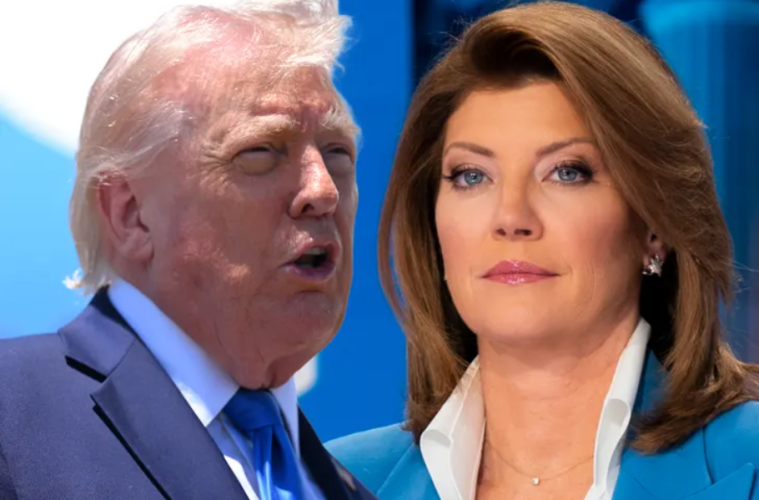
The former president criticizes a controversial interview exchange
Trump Responds to Norah O’Donnell Interview Moment
April 27, 2026 – Donald Trump has sharply criticized Norah O’Donnell following a recent interview exchange that has drawn widespread attention. The moment in question involved a sensitive line of questioning that Trump described as inappropriate, prompting him to label the veteran journalist a “disgrace.”
The comments have quickly circulated across media platforms, reigniting debates about journalistic boundaries, political rhetoric, and the tone of high-profile interviews. As with many interactions involving Trump and major news figures, the exchange has become a focal point for broader discussions about media conduct and accountability.

Image Credit: Getty Images
The Interview and Its Controversial Question
The exchange reportedly took place during a televised interview segment in which Norah O’Donnell posed a question related to a highly sensitive topic involving allegations connected to a broader news context. While the specifics of the question have been widely debated, the framing and wording became the central issue of contention.
Critics of the segment argue that the question crossed a line by introducing a subject that required careful handling. Supporters, however, maintain that journalists have a responsibility to ask difficult questions, particularly when they relate to matters of public concern.
Trump’s Reaction and Public Statement
Donald Trump responded strongly, using pointed language to express his disapproval of both the question and the journalist. His remarks reflect his longstanding approach to media criticism, often characterized by direct and confrontational rhetoric.
This response aligns with Trump’s broader messaging about the press, which has frequently included accusations of bias and inappropriate coverage. His latest comments continue that pattern, adding another layer to his ongoing relationship with major news outlets.
Donald Trump defends himself after ‘60 Minutes’ anchor reads manifesto of gunman from the correspondents dinner, which refers to an administration official as a pedophile and rapist. pic.twitter.com/lNe2xbIiSU
— Pop Base (@PopBase) April 27, 2026
Media Ethics and Sensitive Topics
The controversy highlights an ongoing challenge in journalism: how to address sensitive subjects responsibly while maintaining a commitment to truth and accountability. Questions involving serious allegations require a balance between thorough reporting and careful framing.
In this case, the debate centers on whether the question was necessary and appropriately handled. Journalists often face pressure to address complex issues directly, but they must also consider the potential impact of their approach on public perception and discourse.
Public Reaction and Divided Opinions
Reactions to the exchange have been mixed, reflecting broader divisions in how audiences view both political figures and media institutions. Some viewers have supported Donald Trump’s criticism, agreeing that the question was inappropriate. Others have defended Norah O’Donnell, emphasizing the importance of holding public figures accountable through direct questioning.
This divide underscores the complexity of modern media consumption, where audiences interpret the same moment in vastly different ways based on their perspectives and expectations.

Image Credit: Getty Images
The Role of High-Profile Interviews
Televised interviews involving prominent figures often carry significant weight, shaping public narratives and influencing broader conversations. The interaction between Donald Trump and Norah O’Donnell illustrates how a single question can become a defining moment, drawing attention far beyond the original broadcast.
Such interviews require careful preparation and execution, as both the interviewer and interviewee navigate a complex dynamic of information, perception, and public scrutiny.
Political Rhetoric and Media Relations
The exchange also reflects the ongoing tension between political figures and the media. Donald Trump has frequently positioned himself as a critic of mainstream journalism, while journalists like Norah O’Donnell operate within a framework that prioritizes inquiry and accountability.
This dynamic creates an environment where interactions are often charged and highly scrutinized. The resulting debates contribute to a broader conversation about the role of the press in a democratic society.

Image Credit: CBS Mornings YouTube
Final Thoughts
The latest clash between Donald Trump and Norah O’Donnell highlights the complexities of modern political and media interactions. At its core, the controversy raises important questions about journalistic responsibility, the handling of sensitive topics, and the tone of public discourse.
As discussions continue, the incident serves as a reminder of the delicate balance required in high-profile interviews. Both journalists and public figures play a role in shaping how information is presented and understood, making each interaction a significant moment in the broader media landscape.
FAQs
Q1: Why did Donald Trump criticize Norah O’Donnell?
He objected to a question he considered inappropriate during a televised interview.
Q2: What was the controversy about?
It centers on whether the question asked during the interview was handled appropriately given its sensitive nature.
Q3: How did Trump respond?
He called Norah O’Donnell a “disgrace” and criticized the line of questioning.
Q4: How have people reacted?
Reactions are divided, with some supporting Trump’s criticism and others defending the journalist’s approach.
Q5: What broader issue does this raise?
It highlights ongoing debates about media ethics, accountability, and political rhetoric.
Published by HOLR Magazine