


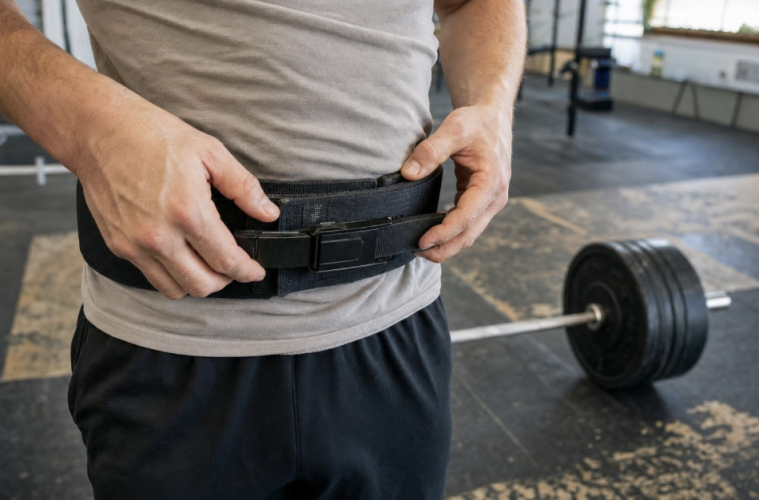
Some lifters wear a belt for every demanding set, while others train without one. If you lift a few days a week and want to get stronger, the right choice depends on your exercises, loads, and ability to brace.
Here is what a lifting belt does, how to size and position one, when it can help, and when you are better off leaving it in your bag.
What a lifting belt actually does
A belt gives your midsection something firm to push against. When you take a deep breath and brace, your abdominal muscles press outward into the belt. This increases pressure inside your abdomen and helps your trunk stay stiff while your legs and hips move the load.
Research using loaded squats suggests that belts can increase abdominal pressure and may produce small improvements in bar speed or the number of repetitions completed before fatigue. Results vary by lifter, exercise, and load, so a belt should not replace sound technique or sensible programming.
A belt also provides physical feedback. Feeling pressure around your waist can remind you to brace in every direction rather than only tightening the front of your stomach.
When a belt helps and when to skip it
Belts are most useful during heavy compound lifts, including back and front squats, deadlifts, overhead presses, and Olympic lifts. These movements place high demands on trunk stability, especially as the weight approaches your limit.
A common guideline is to use a belt for sets at about 80 percent of your one-repetition maximum, meaning the heaviest load you can lift once with good form. That is not a strict rule. Some lifters use one earlier, while others wait until their heaviest working sets.
Light warm-ups, most accessory exercises, machine work, and general conditioning usually do not require a belt. Keeping some sets beltless also gives you regular opportunities to practice bracing without external feedback.
The breath-holding brace used during maximal lifting, sometimes called the Valsalva maneuver, can cause a sharp rise in blood pressure. If you have hypertension or a cardiovascular condition, ask a qualified clinician whether maximal braced lifting is appropriate for you.
Types and styles at a glance
Choosing a belt gets easier when you compare three features: material, width, and closure type.
Tapered Olympic-style belts
Tapered belts are narrower at the front and wider at the back. The narrower front can reduce pinching at the ribs or hips when catching a clean or moving into a deep squat.
Nylon and auto-lock belts
Nylon or neoprene belts are softer, lighter, and quick to adjust. They can be practical for sessions that combine barbell work with circuits or other exercises requiring frequent changes in tightness.
Closure options
- Single prong: Simple and relatively easy to fasten with one hand.
- Double prong: Secure, although slightly more difficult to thread and release.
- Lever: Fast to open and close, but the setting usually requires a tool to adjust.
- Hook-and-loop or friction lock: Highly adjustable but generally less rigid than a leather buckle or lever belt.
A side-by-side comparison, such as the weight belts selection at Kinta Fitness, can help you see how leather, nylon, buckle, and friction-lock designs differ before choosing a style.
Find your fit: sizing and placement
A well-fitted belt should let you breathe and brace while remaining secure throughout the lift. Size, width, and position all affect how it feels.
Measure the right spot
Do not order based on your pants size. Measure around the part of your midsection where the belt will sit, usually near navel level. Take the measurement while standing naturally, then check the sizing chart for the exact model.
When comparing a Kinta Fitness belt or another model, choose a size that places your measurement near the middle of the listed range. This leaves room to adjust the belt if your body weight changes.
Width matters as well. A four-inch belt suits many lifters, while three-inch or tapered designs may work better for Olympic lifting or shorter torsos. If a wide belt blocks your starting position or pinches your ribs and hips, try a narrower shape.
Where the belt should sit
For many lifters, the belt sits just above the hip bones and maintains contact around the torso. Placement is individual, so test small adjustments while performing your actual squat, deadlift, or press setup. If the belt digs into your ribs on one side and floats on the other, it may be too high, too wide, or the wrong shape for your build.
How tight is tight enough?
Start with enough room to slide one or two fingers between the belt and your stomach before bracing. You should still be able to take a full breath into your abdomen and sides. If you cannot inhale comfortably, the belt is too tight to brace effectively.
How to use a belt on your main lifts
A belt works best when it reinforces a bracing technique you already understand. Practice the sequence with moderate loads before using it for a near-maximal attempt.
Bracing step by step
Set the belt in a comfortable position, then take a deep breath that expands your abdomen, sides, and lower back. Push outward against the belt in every direction and maintain that pressure through the hardest part of the repetition. Reset your breath between repetitions instead of trying to hold one breath for an entire heavy set.
A simple practice plan
For the first few weeks, wear the belt only on your top working sets. Keep warm-ups and lighter work beltless so you continue developing independent bracing skills.
What you wear underneath matters more than most lifters expect. A thick waistband or a bunched hem changes where the belt sits, so if you are refining your setup it is worth checking your training gear alongside the belt position rather than adjusting one and blaming the other.
If you choose a Kinta Fitness belt, begin with moderate squat or deadlift sets and note whether the belt stays in place without restricting your setup. Change only one variable at a time, such as tightness or height, so you can identify the position that works best.
A structured beginner gym routine can provide a consistent group of lifts on which to test the belt. Repeating the same movements makes it easier to judge whether the belt improves stability or simply feels unfamiliar.
If you compete, check the rulebook
Competition federations set belt limits, and their rules are not identical. IPF technical rules generally limit belts to 10 cm in width and 13 mm in thickness, with single-prong, double-prong, and lever closures permitted. IWF rules allow belts up to 12 cm wide.
Equipment rules can change, and some events maintain approved-product lists. Check the current rulebook and equipment requirements on your federation’s official site before buying a competition belt or attending equipment inspection.
Common mistakes to avoid
- Wearing a belt for every exercise, including light warm-ups and accessory work.
- Cinching it so tightly that you cannot take a full breath.
- Ordering by pants size instead of measuring your midsection.
- Placing it so high that it presses into your ribs.
- Assuming the belt can compensate for poor technique or unsafe loading.
- Buying a width or thickness that is not allowed by your federation.
The takeaway
A lifting belt is optional. Many people train effectively without one, particularly at light or moderate loads. If you decide to use one, choose a comfortable style, learn to brace with and without it, and reserve it for sets that are heavy enough to benefit from added trunk support.
FAQs
Should beginners use a belt?
Most beginners can train without one while learning basic breathing, bracing, and lifting technique. A belt may become useful once working sets are consistently heavy and technique is stable.
Can I wear a belt for cardio or group classes?
There is usually little benefit. These sessions rarely involve near-maximal loads, and a tight belt can be uncomfortable when you need to breathe quickly for an extended period.
What width should shorter lifters consider?
If a four-inch belt pinches your ribs or hips, consider a three-inch or tapered design. Comfort in your actual squat and deadlift positions matters more than the width alone.
Can a belt replace good lifting technique?
No. A belt supports a solid brace, but it cannot compensate for poor form, unsuitable loading, or rushed progression.