

For years, Albania sat at the edge of European travel conversations , acknowledged but rarely chosen. That’s changing fast. Visitor numbers have climbed steadily, budget airlines now connect Tirana to most major European cities, and a country that spent decades deliberately closed to the outside world is opening up in ways that reward the travellers arriving now, before the infrastructure catches up and the prices follow.
What makes Albania worth the trip isn’t any single thing. It’s the combination , Ottoman old towns, Ionian coastline, Byzantine ruins, mountain villages with no mobile signal, and food that hasn’t been adjusted for tourist expectations. The country has about 450 kilometres of coastline and a mountain range, the Albanian Alps, that serious hikers are only just beginning to discover.
But if you ask most people who’ve been what they remember most, the answer is usually the same: somewhere in the north, on the water.
The North Is Where It Gets Serious
Shkodër is the gateway. Albania’s fourth-largest city sits at the edge of the Alps, two hours from Tirana, and serves as the base for everything that follows. The city itself has improved significantly as a destination , Rozafa Castle above the lake, a growing restaurant scene, the old bazaar , but most people use it as a launchpad.
An hour east of Shkodër, the landscape changes register entirely. The Drin River canyon opens up, the roads get narrower, and the first glimpse of Komani Lake , that electric turquoise water between cliffs rising several hundred metres , tends to stop people mid-sentence.
Shala River: The Pearl of Albania
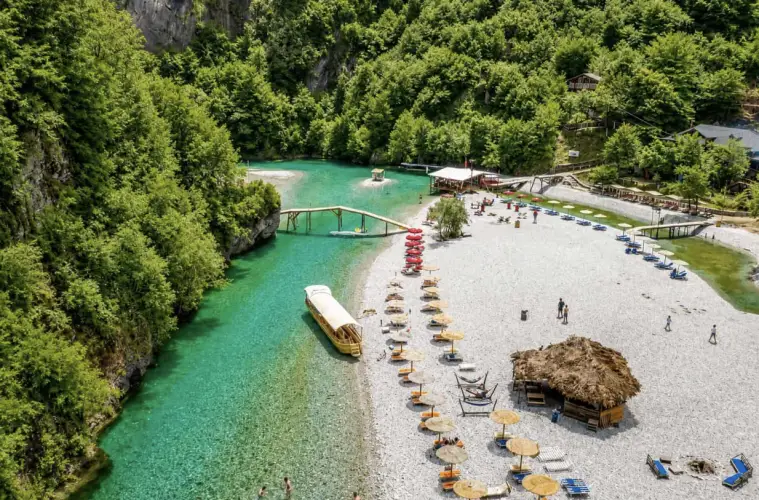
Deep inside the canyon system, where Komani Lake narrows and the rock walls press to within touching distance of the water, the Shala River begins. It has been called the “Thailand of Albania” , a comparison that undersells both places, but captures something true about the colour of the water and the sense of improbable natural beauty somewhere you didn’t expect to find it.
The Shala River canyon is one of those places that photographs accurately but still manages to surprise in person. The water is clear to the riverbed, cold even in the height of summer, and a shade of turquoise that doesn’t exist on any colour chart. The pebble beaches are white and fine. The canyon walls above are limestone, several hundred metres high, draped in forest right to the ridgeline.
There are no roads to the Shala River. The only way in is by boat from Koman Lake , a 45-minute cruise through the canyon that is, on its own, worth the journey north.
One of the best tour operators running those boats is North Albania Boat, whose daily tour departs Koman at 9:00 AM and arrives at Shala River around 10:15 AM, leaving guests with four and a half to five hours to swim, kayak the inner canyon, or simply sit on the beach and look at the cliffs. The return reaches Koman by 3:30 PM. Tours run April through October from €25 per person.
It’s the kind of day that recalibrates your sense of what European travel can still offer.
Why Now
Albania is in a specific window of time that experienced travellers recognise and move toward. The infrastructure has improved enough to be comfortable. The crowds haven’t arrived yet in the way they have in Croatia or Montenegro. The prices remain low. The landscape is largely intact.
The southern Riviera will eventually look like every other Mediterranean coastline that discovered tourism. Tirana will keep growing into its role as a small European capital. But the north , the canyons, the Alps, the river that runs turquoise through limestone , will be harder to change.
The people arriving in Albania now are getting something that won’t be available indefinitely: a country that is genuinely discovering itself as a destination, where the most extraordinary places still feel like your own find rather than a checked box on someone else’s list.
Shala River is the clearest version of that. Go before everyone else figures it out.
Published by HOLR Magazine.