


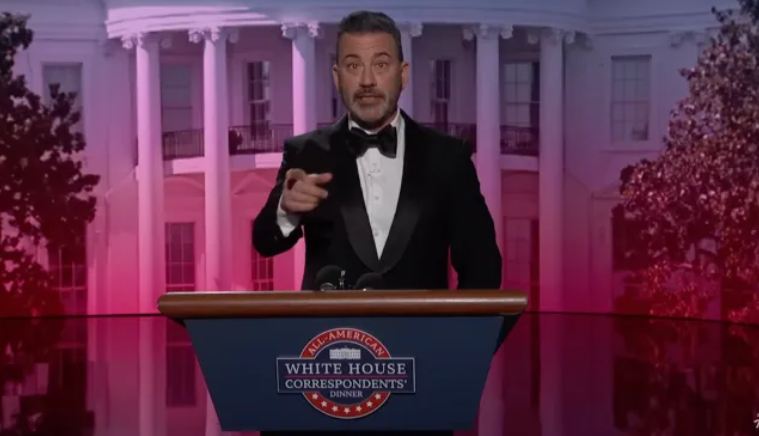
Late-night satire steps in with a parallel political roast
Kimmel brings the Correspondents’ Dinner format to TV
April 24, 2026 – Jimmy Kimmel reimagined the spirit of the White House Correspondents’ Dinner by delivering his own “alternative” roast on late-night television, placing Donald Trump at the center of the segment. Rather than relying on the traditional Washington setting, Kimmel used his platform to recreate the tone of the event while adapting it for a broader television audience.
The move reflects a growing trend where late-night hosts reinterpret established formats, allowing them to engage viewers beyond the confines of formal political events. By doing so, Kimmel positioned his segment as both entertainment and commentary.
Image Credit: Getty Images
A modern twist on a long-standing tradition
The White House Correspondents’ Dinner has historically been a space where journalists, politicians, and entertainers come together for a night of humor and reflection. Roasts delivered at the event often blend satire with critique, offering a unique lens on the political climate.
Kimmel’s “alternative” version preserves that essence but shifts it into a more accessible format. Without the constraints of a formal audience, the segment allows for a freer, more direct comedic approach, tailored to viewers at home.
Trump as the central focus of the satire
Donald Trump served as the primary target of Kimmel’s jokes, with the host drawing on both past actions and ongoing political narratives. The roast reportedly combined sharp punchlines with broader commentary, reflecting Kimmel’s established style.
Political satire often relies on exaggeration and contrast, and Kimmel’s segment used these tools to highlight perceived inconsistencies and controversies. By focusing on Trump, the roast tapped into a figure who continues to generate significant public attention and discussion.

Image Credit: Getty Images
The evolving role of late-night television
Late-night shows have increasingly become platforms for political commentary, blending humor with analysis in a way that resonates with contemporary audiences. Jimmy Kimmel has been a key figure in this evolution, frequently addressing current events through a comedic lens.
This shift reflects changing audience expectations, where viewers look to entertainment platforms not only for humor but also for perspective on the news. Segments like this “alternative” roast demonstrate how late-night television continues to adapt to these demands.
Humor as a tool for political engagement
Satire has long played a role in making political topics more approachable. By framing commentary through humor, hosts like Kimmel can engage audiences who might otherwise feel disconnected from traditional political discourse.
The roast format is particularly effective in this regard, as it allows for critique to be delivered in a way that is both entertaining and thought-provoking. This balance is central to the success of segments that aim to inform as well as amuse.
Audience reactions and cultural impact
The segment quickly generated conversation across social media and entertainment platforms, with viewers sharing clips and reactions. Political satire often produces a wide range of responses, reflecting the diversity of audience perspectives.
For some, the roast serves as a form of commentary that aligns with their views, while others may see it as overly critical or partisan. This range of reactions underscores the influence of late-night television in shaping public discourse.
Image Credit: Getty Images
The flexibility of traditional formats
By creating an “alternative” version of the White House Correspondents’ Dinner, Kimmel demonstrates how traditional formats can be adapted for new contexts. This flexibility allows creators to maintain familiar structures while introducing fresh elements.
Such adaptations are increasingly common in modern media, where audiences expect innovation alongside tradition. The success of these formats depends on their ability to balance both.
The intersection of entertainment and politics
The segment highlights the ongoing intersection between entertainment and politics, where comedians and hosts play a role in interpreting current events. This blending of genres reflects a broader shift in how information is consumed and understood.
Jimmy Kimmel’s approach illustrates how humor can serve as a bridge between these worlds, making complex topics more accessible to a wider audience.

Image Credit: Win McNamee / Getty Images
What this means for future late-night content
The positive engagement around the segment suggests that audiences are receptive to alternative formats that combine humor with commentary. This could encourage further experimentation within late-night programming, with hosts exploring new ways to connect with viewers.
For Kimmel, it reinforces his position as a host willing to adapt and innovate, keeping his content relevant in a rapidly changing media landscape.
Final Thoughts
Jimmy Kimmel’s “alternative” roast of Donald Trump offers a compelling example of how late-night television continues to evolve. By reimagining a traditional political event, he brings satire to a wider audience while maintaining its core purpose of critique and reflection.
As the boundaries between entertainment and political commentary continue to blur, segments like this highlight the enduring power of humor to engage, inform, and spark conversation.
FAQs
Q1: What did Jimmy Kimmel do?
He delivered an “alternative” Correspondents’ Dinner-style roast on his show.
Q2: Who was the main focus of the roast?
Donald Trump was the central figure in the satire.
Q3: What is the Correspondents’ Dinner?
It is an annual event featuring speeches and comedic roasts of political figures.
Q4: Why is this segment significant?
It adapts a traditional political event for a television audience.
Q5: How have viewers reacted?
Reactions are mixed, with strong engagement and discussion online.
Published by HOLR Magazine