


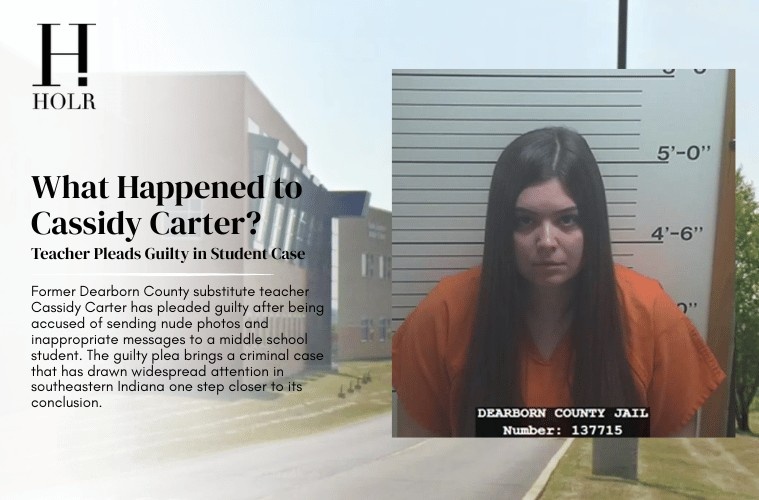
HOLR HIGHLIGHTS
The key details readers need to know.
- Former Dearborn County substitute teacher Cassidy Carter has pleaded guilty after being accused of sending nude photos and inappropriate messages to a middle school student. The guilty plea brings a criminal case that has drawn widespread attention in southeastern Indiana one step closer to its conclusion.
- Investigators say the communication took place through Snapchat and other electronic messages. The case began after the student reported the interactions, prompting an investigation by law enforcement and school officials.
- Rather than proceeding to trial, Carter accepted a plea agreement that reduced the original charges. The latest court hearing officially resolved the criminal case while raising renewed discussions about educator boundaries and student safety.
July 7, 2026
When allegations of inappropriate communication between a teacher and a student first surfaced in Dearborn County, Indiana, many parents expected a lengthy legal battle.
Instead, months after investigators launched their inquiry, former substitute teacher Cassidy Carter has admitted guilt in court, bringing one of the area’s most closely watched educator misconduct cases to a close.
The case has attracted significant attention not only because it involved a school employee and a minor but also because it also highlighted how quickly private conversations on social media can become central pieces of criminal investigations.
Although the original allegations included accusations that Carter sent explicit photographs to a student, the legal proceedings ultimately ended differently than many expected.
Rather than taking the case before a jury, prosecutors and Carter’s defense team reached a plea agreement that resolved the matter without a trial.
Now, with court proceedings largely complete, attention has shifted from the allegations themselves to the broader questions surrounding student safety, educator accountability, and how schools respond when concerns involving staff members are reported.
Who Is Cassidy Carter?
Before her arrest made local and national headlines, Cassidy Carter worked as a substitute teacher in Dearborn County, serving students across the southeastern Indiana school district.
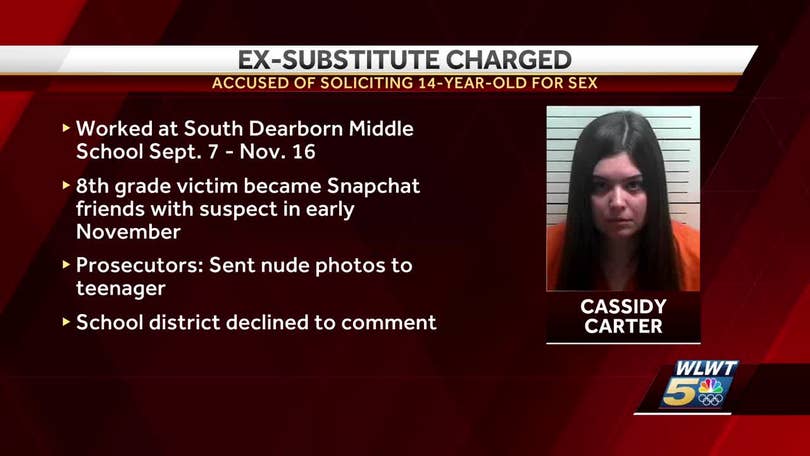
WLWT
Substitute teachers often move between classrooms and grade levels, stepping in when regular teachers are unavailable. Like all educators, they are expected to maintain professional boundaries with students both inside and outside the classroom.
According to court records, Carter’s role as an educator became a central focus of the investigation after authorities alleged she engaged in inappropriate communication with a middle school student outside of school.
While investigators have not publicly suggested the case involved physical contact, prosecutors argued that the electronic messages themselves were serious enough to warrant criminal charges.
The allegations quickly drew concern throughout the community, where parents questioned how the communication began and whether additional safeguards could help prevent similar situations in the future.
How the Investigation Began
According to investigators, the case began after a middle school student disclosed inappropriate online communication involving Carter.
Authorities allege that the conversations took place primarily through Snapchat, a messaging platform where photos and messages are designed to disappear after being viewed.
AOL
After the student’s report, detectives began reviewing digital evidence, including electronic communications that investigators believed supported the allegations.
Court documents state that the investigation eventually uncovered explicit photographs allegedly sent by Carter, along with additional messages that prosecutors argued crossed professional boundaries expected of educators.
As investigators continued gathering evidence, school officials cooperated with law enforcement while the criminal investigation moved forward.
The findings ultimately led prosecutors to file multiple criminal charges against the former substitute teacher.
For many parents in Dearborn County, the allegations served as a reminder of how communication between students and adults increasingly extends beyond classrooms and into private messaging applications, creating new challenges for both families and schools.
The Allegations That Led to Criminal Charges
Following the investigation, prosecutors accused Carter of sending sexually explicit material to the student through electronic messaging.
According to court records, the allegations centered on digital communication rather than accusations of physical abuse.
Authorities have not publicly released the full contents of the messages in order to protect the identity and privacy of the minor involved.
Instead, court filings focused on whether the electronic material allegedly shared with the student violated Indiana law governing harmful matter sent to minors.
As news of the case spread, it received significant attention across Indiana, with many community members closely following each court appearance to see how the criminal proceedings would unfold.
At the time, prosecutors maintained that the evidence gathered during the investigation justified the charges filed against Carter, while her defense prepared to challenge the allegations as the case moved through the court system.
Why the Case Never Went to Trial
As the case moved through Indiana’s court system, prosecutors and Carter’s defense team reached an agreement that changed the course of the proceedings.
Rather than asking a jury to decide the case, Carter accepted a plea agreement and pleaded guilty to disseminating matter harmful to minors, a lesser offense than some of the charges she originally faced.
In exchange for the guilty plea, prosecutors agreed to dismiss the remaining charges, bringing months of legal proceedings to an end without the need for a trial.
Plea agreements are common in criminal cases and allow both the prosecution and the defense to resolve a matter while avoiding the uncertainty and emotional toll of courtroom testimony.
Although the agreement reduced the charges, Carter’s guilty plea still resulted in a criminal conviction, marking a significant outcome in a case that had drawn widespread attention throughout Dearborn County.
For many in the community, the plea also answered one of the biggest questions surrounding the investigation—whether the allegations would ultimately be contested before a jury or resolved through negotiations.
The Latest Court Update
During the most recent court hearing, Carter formally entered her guilty plea before a Dearborn County judge.
The court accepted the agreement after determining that Carter understood the charge against her and the consequences of pleading guilty.
With the plea accepted, the criminal case officially moved into its final stage.

Dearborn county Jail
Although the legal proceedings have largely concluded, the conviction is expected to have long-term consequences beyond the courtroom.
Like many educators convicted of offenses involving students or minors, Carter may face additional professional consequences related to future employment and any applicable licensing or certification requirements.
While the criminal case has reached a conclusion, the impact of the conviction is likely to extend well beyond the sentence imposed by the court.
A Case That Sparked Wider Conversations
Beyond the courtroom, the case has prompted renewed discussions about the responsibilities educators carry when interacting with students.
Schools today rely heavily on digital communication, and while technology has created new ways for teachers and students to stay connected academically, it has also reinforced the importance of maintaining clear professional boundaries.
Law enforcement officials continue encouraging parents to speak openly with their children about online communication and to report anything that feels inappropriate or concerning.
The case has also highlighted the growing role digital evidence now plays in criminal investigations.
From disappearing Snapchat messages to recovered electronic records, investigators increasingly depend on technology to reconstruct conversations and determine what occurred during alleged offenses.
For many families in Dearborn County, the investigation served as a reminder that safeguarding students extends beyond the classroom and into the online spaces where young people spend much of their time.
What Happens Next?
Although the criminal proceedings against Cassidy Carter have now been resolved through her guilty plea, the case continues to leave lasting questions about educator accountability and student protection.
For Carter, the guilty plea closes one chapter of the legal process but may carry consequences that affect future employment opportunities for years to come.
For the school community, the case has reinforced the importance of reporting concerns early and ensuring allegations involving students receive immediate attention from both school officials and law enforcement.
Officials have not indicated that additional criminal charges are expected, and with the plea agreement accepted, the case is now considered legally resolved.
Even so, it remains one of the most closely followed educator misconduct cases in southeastern Indiana in recent months.
FAQs
Who is Cassidy Carter?
Cassidy Carter is a former substitute teacher from Dearborn County, Indiana, who pleaded guilty after being accused of sending explicit photographs and inappropriate electronic messages to a middle school student.
What happened to Cassidy Carter?
Authorities investigated Carter after a student reported inappropriate online communication. She later accepted a plea agreement and pleaded guilty to disseminating matter harmful to minors, resolving the criminal case without a trial.
What was Cassidy Carter accused of?
Investigators alleged that Carter sent nude photographs and sexually explicit messages to a middle school student through Snapchat and other electronic communications.
Why did Cassidy Carter plead guilty?
Rather than proceeding to trial, Carter accepted a negotiated plea agreement that reduced the original charges while resulting in a criminal conviction.
Where did the case happen?
The investigation took place in Dearborn County, Indiana, involving a middle school student and a former substitute teacher.
Has the case been resolved?
Yes. Carter’s guilty plea has brought the criminal proceedings to a conclusion, although the conviction may continue to have professional consequences.