


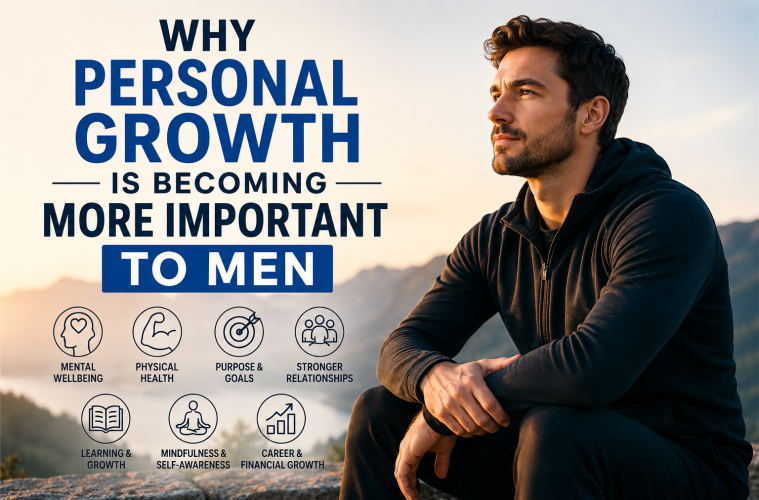
Why Personal Growth Is Becoming More Important to Men
From fitness and career goals to emotional wellbeing, relationships and self-awareness, more men are beginning to view personal growth as a lifelong process rather than a race to prove themselves.
August 11, 2026: For a long time, conversations about men’s self-improvement seemed to follow a familiar formula: work harder, earn more, build muscle, become more confident and keep pushing.
There is nothing inherently wrong with wanting to become stronger, healthier or more successful. However, the conversation around what it means to improve as a man is becoming broader.
In 2026, personal growth is increasingly being discussed alongside emotional wellbeing, relationships, purpose, self-awareness and the ability to ask for help. The Global Wellness Institute’s 2026 men’s wellbeing trends report points to growing attention around social connection, mental health, fatherhood, men’s health and new approaches to wellbeing.
HOLR breaks down why personal growth is becoming more important to men and why today’s version of self-improvement looks different from the traditional “work harder and toughen up” message.

Image Credit: mensgroup.com
Personal Growth Is Becoming Bigger Than Fitness
Fitness has long been one of the most visible forms of male self-improvement.
Going to the gym, building strength and improving physical health can be positive goals. But the modern conversation is expanding beyond appearance and performance.
Recent reporting on men’s health trends shows that men are increasingly looking beyond muscle and performance toward areas such as immunity, mood, longevity and everyday wellbeing.
That shift matters because physical health is only one part of a person’s life.
A man can be physically fit and still feel disconnected from his friends, uncertain about his career or unable to communicate what he is feeling.
Personal growth creates room for those parts of life, too.
The goal is becoming less about looking like you have everything together and more about actually feeling capable of handling your life.
Men Are Rethinking What Strength Means
Traditional ideas about masculinity have often emphasized independence, emotional control, toughness and self-reliance.
Those qualities can have positive sides. Independence can build confidence, while resilience can help people navigate difficult circumstances.
The problem comes when those ideas leave no room for vulnerability.
Research and men’s health organizations are increasingly discussing a broader understanding of masculinity that can include emotional expression, self-awareness, care for others and help-seeking. Healthy Male, an Australian men’s health organization, notes that masculine norms can influence health and that qualities such as emotional expression and self-awareness are increasingly being valued alongside traditional ideas of masculinity.
That does not mean men are abandoning strength.
It means the definition of strength is becoming more complete.
Being able to say “I need help” can require just as much courage as handling a difficult situation alone.
Emotional Awareness Is Becoming Part of Self-Improvement
For years, personal development content aimed at men often focused on external achievements.
Improve your body.
Improve your income.
Improve your appearance.
Improve your career.
Now, emotional intelligence is increasingly part of the conversation.
That can mean learning to identify emotions, communicate more clearly, recognize unhealthy patterns and understand how personal behavior affects other people.
These skills can be useful at work, in friendships, romantic relationships and family life.
They also make personal growth less about becoming an entirely different person.
Instead, it becomes about understanding the person you already are.

Image Credit: mensgroup.com
Relationships Are Becoming Part of the Growth Conversation
Personal growth is sometimes presented as an individual project.
Wake up earlier. Exercise. Read more. Work harder.
But relationships are an important part of a fulfilling life, and men’s wellbeing conversations are increasingly recognizing the role of social connection.
The Global Wellness Institute identified social disconnection as a significant theme in its 2026 men’s wellbeing trends, noting that men are increasingly turning to online spaces for mental health support while real-world connection remains an important concern.
This creates an interesting contradiction.
A man can have thousands of online followers and still feel lonely.
He can be constantly connected digitally while lacking a few people he can call when life becomes difficult.
Personal growth, therefore, can involve something as simple as investing more time in friendships.
Friendship Is Not a Sign of Weakness
One of the healthiest changes in the conversation around men’s personal development is the recognition that friendship matters.
Men do not necessarily need a large social circle.
Sometimes they need a few relationships where they can be honest without feeling judged.
That could mean making time for an old friend, joining a sports group, participating in a community activity or simply becoming more intentional about maintaining relationships.
The Global Wellness Institute’s 2026 report also highlights the growth of men’s wellbeing communities and initiatives designed to create stronger connections.
This is important because personal growth becomes difficult when it happens entirely in isolation.
People need people.
Career Success Is Still Important—but It Is Not Everything
Ambition remains an important part of personal growth.
Men still want to build careers, start businesses, earn more money and create financial stability. There is nothing wrong with those goals.
The difference is that success is increasingly being questioned on a personal level.
A person can have an impressive job and still ask:
Am I happy?
Do I have enough time for the people I love?
Does my work have meaning?
What do I actually want?
Those questions do not necessarily mean someone is dissatisfied with success.
They can mean that success is being measured more broadly.
Instead of asking only, “How much have I achieved?”, personal growth asks, “What kind of life am I building?”

Image Credit: mensgroup.com
Men Are Looking for Purpose, Not Just Productivity
Productivity culture has encouraged people to optimize almost every part of their day.
There are apps for scheduling, fitness trackers for exercise, programs for productivity and endless online advice about becoming more efficient.
But efficiency does not automatically create fulfillment.
The broader self-growth conversation in 2026 is moving toward balance, emotional clarity and sustainable habits rather than endless optimization.
For men, that can mean reconsidering what productivity is actually for.
Working harder makes sense if it helps create the life you want.
But if work leaves no time for relationships, rest or personal interests, simply becoming more productive may not solve the underlying problem.
Personal growth is not supposed to turn life into a never-ending performance review.
Fatherhood Is Becoming Part of Men’s Wellbeing
Another important development is the growing recognition of fatherhood as part of men’s health and wellbeing.
The Global Wellness Institute identifies fatherhood as an emerging men’s health issue, reflecting a broader understanding that becoming a parent can affect a man’s emotional, social and physical wellbeing.
Fatherhood can change priorities overnight.
It can encourage men to think differently about work, relationships, health and the kind of example they want to set.
Personal growth in this context is not about becoming perfect.
It can be about becoming more present.
That might mean learning how to communicate better, becoming more patient or making space for family responsibilities alongside professional ambitions.
The Internet Has Changed the Way Men Learn About Self-Improvement
Men have more access to self-improvement content than ever.
YouTube, TikTok, podcasts and online communities can provide advice about fitness, careers, relationships, finances and emotional wellbeing within seconds.
That access can be useful.
It can also be overwhelming.
The Australian Psychological Society warned in 2026 that online subcultures can influence how young men understand masculinity and wellbeing, with some spaces exploiting vulnerabilities rather than providing healthy guidance.
This is an important part of the personal-growth conversation.
Not every piece of advice marketed as “self-improvement” is actually helpful.
Some content encourages discipline and healthy habits.
Other content can turn insecurity into a business model, promising that expensive programs, extreme routines or unrealistic physical standards will solve someone’s life.
Real growth requires knowing the difference.
The Pressure to Constantly Improve Can Become Its Own Problem
Personal growth sounds positive, but there is a point where self-improvement can become exhausting.
A man does not need to optimize every aspect of himself.
He does not need to become stronger every week, earn more every year, wake up at a certain hour or transform his appearance to have value.
This is especially important as social media makes comparison easier.
Research into men’s online fitness culture has raised concerns about muscular ideals and the way highly visual platforms can reinforce body-image pressures among boys and young men. A 2026 study of #GymTok content found that more muscular and potentially harmful content could receive higher engagement, highlighting how algorithms may amplify certain physical ideals.
That is why healthier personal growth needs to include self-acceptance.
Improvement should not begin with the belief that a person is fundamentally inadequate.
Personal Growth Can Mean Asking for Help
Perhaps one of the biggest changes is the growing recognition that asking for help can be part of becoming stronger.
That might mean talking to a trusted friend, speaking with a mental health professional, seeking career advice or admitting that something is not working.
A 2026 Australian government initiative called Men in Mind is specifically focused on helping healthcare professionals better recognize and respond to men’s mental health needs. The program emphasizes approaches such as reframing masculinity and meeting men where they are.
The existence of programs like this reflects a larger conversation.
Men’s wellbeing cannot be reduced to physical fitness or financial success.
Mental and emotional health matter, too.
Personal Growth Is Becoming More Human
Perhaps the biggest change is that personal growth is becoming less about creating an impressive version of yourself for other people.
It is increasingly about becoming more comfortable with yourself.
That could mean recognizing your strengths without pretending you have no weaknesses.
It could mean improving your health without becoming obsessed with appearance.
It could mean working toward career success while protecting your relationships.
It could mean becoming more emotionally available to your partner, children or friends.
And it could mean accepting that growth is not always visible.
Sometimes growth looks like walking away from something unhealthy.
Sometimes it looks like apologizing.
Sometimes it means changing your mind.
Sometimes it means finally admitting that you need support.
Not every important improvement can be measured by a number on a scale, a bank account or a job title.
Why This Shift Matters
The growing interest in personal development among men is not about suggesting that older ideas of masculinity are automatically wrong.
It is about expanding the options.
A man can be ambitious and emotionally open.
He can be physically strong and vulnerable.
He can value independence while still asking for help.
He can care about his career while making time for his family.
He can want to improve himself without believing that he is not good enough as he is.
That broader definition is ultimately what makes personal growth more sustainable.
The Future of Men’s Personal Growth
As conversations about men’s wellbeing continue to develop, personal growth is likely to become increasingly connected to the whole person.
Fitness will remain important.
Career ambition will remain important.
Financial stability will remain important.
But so will friendships, emotional intelligence, purpose, family, rest and self-awareness.
The Global Wellness Institute’s 2026 trends suggest that men’s wellbeing is moving toward a broader ecosystem involving health, connection, sport, fatherhood and community.
That is a meaningful shift.
Personal growth is no longer simply about becoming tougher, richer or more successful. It is about becoming more capable of building a life that actually feels meaningful.
And perhaps that is why the conversation is becoming more important to men now.
The goal is not perfection.
It is progress.
It is learning.
It is becoming more aware of what matters.
And ultimately, it is creating a version of success that feels worthwhile even when nobody else is watching.
HOLR breaks down the latest lifestyle and wellbeing conversations, and the growing focus on men’s personal growth suggests that the next chapter of self-improvement may be less about proving something to the world—and more about understanding yourself.
FAQs
Why is personal growth becoming more important to men?
Personal growth is expanding beyond traditional goals such as fitness and career success to include emotional wellbeing, relationships, purpose, self-awareness and social connection.
What does personal growth mean for men?
Personal growth can include improving physical health, developing emotional awareness, building stronger relationships, pursuing meaningful goals, learning new skills and becoming more comfortable asking for support.
Why are men talking more about emotional wellbeing?
Men’s wellbeing initiatives and health organizations are increasingly recognizing emotional health, self-awareness and help-seeking as important parts of overall wellbeing.
What are the biggest stories trending online today? Read the latest here
Published by HOLR Magazine
Image Credit: AI