


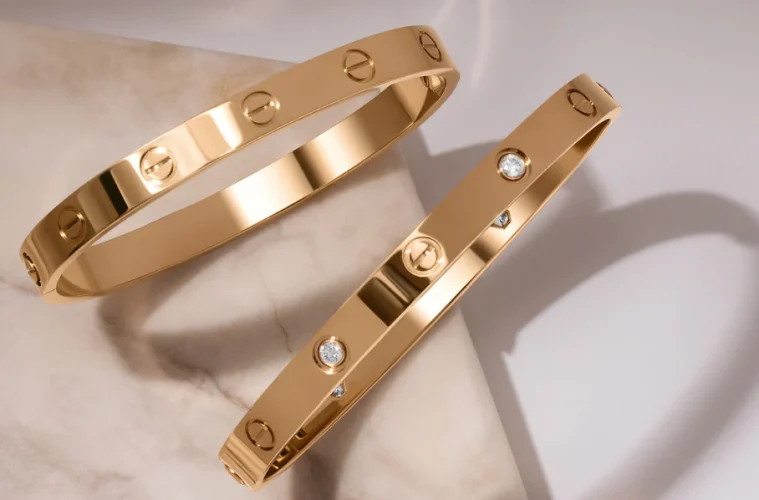
Some jewellery rarely falls out of rotation. The Cartier Love bracelet, with its distinctive screw motifs, has been worn since 1969. Juste un Clou, the nail-shaped bracelet that followed in 1971, still looks modern. Trinity’s interlocking bands have been a staple for a century. These are not short-lived accessories. They are recognisable designs with long track records, and buying them pre-owned can be a practical way to enter the world of luxury jewellery.
Whether you are considering your first serious piece or adding to a growing collection, second-hand Cartier bracelets offer the same design history, craftsmanship, and everyday wearability as their brand-new counterparts. The pre-owned market also gives you access to discontinued variations, supports a more circular approach to fashion, and can make the buying process feel more considered once you know what to check.
This guide walks you through the key bracelet families, how to authenticate what you find, where to shop with confidence, and how to wear and care for your bracelet once it is on your wrist.
Why Pre-Owned Cartier Is Popular
Scroll through current style coverage and you will notice a clear pattern: quiet luxury, simple stacking, and jewellery that looks like it has always belonged in the wardrobe. Cartier bracelets fit that mood well. Love and Juste un Clou are clean enough for daily wear but distinctive enough to stand on their own.
Buying pre-owned offers that same appeal, with a few added benefits:
Enduring design and craftsmanship. These bracelets were made to last. A well-maintained second-hand piece can wear and feel much like one bought new.
A more circular choice. Choosing pre-owned extends a product’s useful life and reduces demand for newly produced materials.
Access to discontinued pieces. The pre-owned market is often the only place to find retired colourways, limited-run variations, or older sizing configurations that Cartier no longer produces.
A more considered purchase. Shopping second-hand encourages research, which usually helps you choose the right bracelet for your wrist and wardrobe.
Meet the Icons
Before comparing listings, it helps to understand the main Cartier bracelet families and how they differ in shape, closure, fit, and overall feel.
Love
Introduced in 1969 and designed by Aldo Cipullo, the Love bracelet is defined by its flat, oval shape and repeating screw motifs. It fastens with a secured screw system, so you need a small screwdriver, usually included with the bracelet, to put it on and take it off. Most versions come in 18-karat yellow, white, or rose gold, with or without diamonds. Sizing is snug by design, so getting the right fit matters more here than with most bangles.
Juste un Clou
Often considered Love’s bolder sibling, Juste un Clou reimagines a carpenter’s nail as a wrap-around bracelet. Also attributed to Cipullo and introduced in 1971, the current production version uses a hinged closure rather than screws, making it easier to put on by yourself. Available in similar metals and finishes, it suits people who want a statement piece that still reads as everyday jewellery.
Trinity and Panthère
Trinity’s three interlocking bands, in yellow, white, and rose gold, were created by Louis Cartier in 1924 and make it one of the most recognisable Cartier silhouettes. The three bands represent love, friendship, and fidelity. Panthère, with its flexible mesh-link construction and feline-inspired detailing, sits at the dressier end of the range. Both appear regularly on the pre-owned market and can stack well with Love or Juste un Clou.
Desirability Without the Hype
Cartier bracelets tend to remain desirable over time because of strong brand recognition, evergreen design, and deep cultural visibility. You will hear people describe them as investments, but it is better to be precise: resale outcomes vary depending on condition, configuration, market demand, and timing. A scratched bracelet without its original box will not attract the same interest as one in near-new condition with full paperwork.
What you can reasonably expect is that these designs have stayed relevant for decades. That kind of staying power is unusual in fashion, and it is one reason pre-owned luxury jewellery continues to attract both first-time and repeat buyers.
Sustainability and Circular Style
Every pre-owned bracelet that finds a new home is one fewer piece that needs to be mined, refined, and manufactured from scratch. The idea is simple: extending a product’s life cycle can reduce the environmental footprint linked to producing luxury goods.
Circular fashion does not require dramatic lifestyle changes. It can be as straightforward as choosing a second-hand Cartier bracelet over a brand-new one when the quality, condition, and price meet your standards. Organizations such as the Ellen MacArthur Foundation have outlined how circular consumption models apply across industries, including fashion and luxury goods. Pre-owned jewellery fits naturally into that approach because fine materials and classic designs can last for decades.
Authentication Essentials
Counterfeits exist, and some are convincing. Before you commit to a purchase, especially a high-value one, know what to look for and ask for clear documentation.
What to Check
Cartier signature. Authentic pieces feature a clean, precisely engraved Cartier signature in a font and placement that vary by model and production year.
Serial number. Each bracelet carries a unique alphanumeric serial number, meaning a code specific to that individual piece, engraved on the interior surface.
Metal hallmarks. Look for fineness stamps such as 750, which indicates 18-karat gold. These hallmarks should be crisp and consistently positioned.
Weight and finish. Genuine Cartier bracelets have a substantial, balanced feel. The finish should be even, with no rough spots or bubbling around engravings.
Closure quality. Screws on the Love bracelet should turn smoothly. Hinges on Juste un Clou should open and close without wobbling.
Provenance. Original box, papers, and service records add confidence. They are not always required, but their absence should be reflected in how carefully you review the piece.
Red Flags
A price that sits far below normal market ranges for the model and metal.
Mismatched or inconsistent fonts on engravings.
Blurry or limited photos that obscure hallmarks and serial numbers.
A seller who will not provide additional images or documentation.
For any significant purchase, consider having the bracelet examined by an independent appraiser or a professional authentication service before finalising the sale.
Shopping Playbook: Where and How to Buy Pre-Owned Cartier
If you are looking to buy a second hand Cartier bracelet, specialist pre-owned retailers are a strong starting point. Compare hallmark photos, condition notes, and sizing before you commit. Beyond dedicated jewellers, auction houses such as Sotheby’s and Christie’s regularly feature Cartier lots, while vetted online marketplaces can offer a wider selection. Each channel has trade-offs in pricing transparency, return policies, and buyer protections.
Regardless of where you shop, look for these basics:
A clearly stated return or exchange policy.
An authenticity guarantee or third-party verification.
High-resolution photos of hallmarks, serial numbers, and closures.
Accurate measurements, including inner diameter.
Transparent information about shipping, insurance, and any applicable taxes or duties.
If you are buying from a seller in a different country, be aware that cross-border purchases may incur import duties and taxes. Check current rules through the relevant customs authority before you order, so there are no surprises at delivery.
Sizing and Comfort
Cartier publishes a size guide for its Love bracelets, and the same principles apply to pre-owned purchases. Measure your wrist just below the wrist bone with a flexible tape measure. Note the measurement in both centimetres and inches, since sizing charts may use either.
Love bracelets fit close to the wrist by design, so most people choose a size that leaves roughly one finger’s width of space. If you plan to stack, you may want to size up slightly to make room for neighbouring pieces. Juste un Clou and Trinity tend to have a bit more play, depending on the specific model and year.
When buying pre-owned, always confirm the inner diameter with the seller rather than relying on a size label alone. Older production runs may use slightly different dimensions than current charts suggest.
Style It Your Way
One of the easiest things about Cartier bracelets is that they do not require much styling effort. A single Love bracelet on a bare wrist works for the office. Stack it with a Juste un Clou or a simple chain bracelet for the weekend. For evening, a Trinity bangle paired with a watch can create a polished, layered effect without looking overdone.
Mixing metals is more accepted than ever. A rose-gold Love next to a yellow-gold Juste un Clou reads as intentional, not mismatched. The key is keeping the rest of your accessories simple so the bracelets remain the focal point.
Care and Aftercare
These bracelets are built to be worn daily, but a few habits will help keep them looking sharp for years.
Gentle cleaning. A soft cloth and warm, soapy water are enough for routine maintenance. Avoid abrasive cleaners or ultrasonic machines at home.
Safe storage. Store bracelets separately in a soft pouch or lined compartment to prevent scratches.
Periodic checks. Inspect screws on the Love bracelet and clasps on hinged models every few months. A loose screw is easy to tighten but easy to lose.
Professional service. Cartier and qualified independent jewellers can assess polishing and refurbishment needs. Be mindful that over-polishing can soften engraved edges over time, so reserve it for when it is genuinely needed.
When Buying New Might Make More Sense
Pre-owned is not always the right call. If you want a custom engraving on a tight timeline, need an exact size that is hard to find second-hand, or are gifting the bracelet and want the full boutique unboxing experience, buying new from Cartier directly may be more practical. There is no single right answer. The goal is to match the buying method to the occasion, budget, and priorities.
The Bottom Line
Second-hand Cartier bracelets offer iconic design, strong craftsmanship, and a more circular approach to luxury. They may also provide access to pieces that are no longer available new. When you authenticate carefully, confirm sizing, and shop through reputable channels, you can end up with a bracelet that feels personal, wearable, and built to last.
Published by HOLR Magazine