


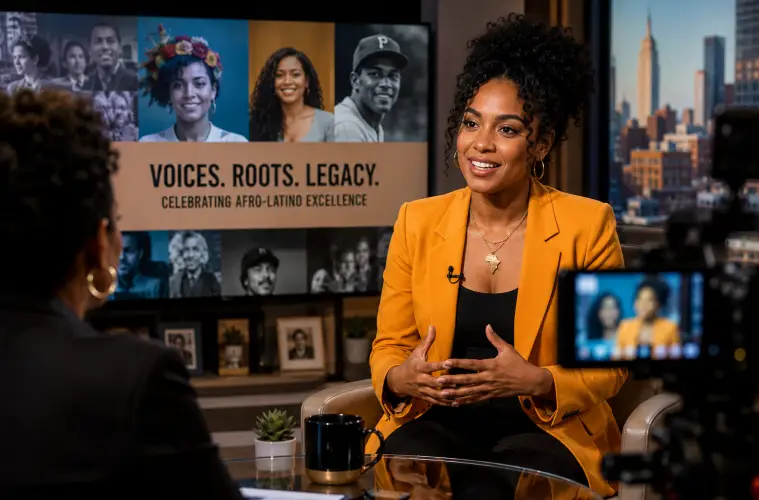
Who gets to be both Black and Latino on screen without having to explain it?
You can probably think of a few names now, but for a long time the answer was basically no one. You grew up hearing Latin music at cookouts, watching “Latino” characters on TV, maybe following baseball players from the Caribbean or footballers from Brazil.
Yet the Afro part of Afro-Latino stayed in the shadows. Community knew it was there; mainstream stuff pretended it wasn’t.
That’s starting to crack. This new wave of Afro-Latino icons is stitching those halves back together, and we’re about to meet them up close.
Why Afro-Latino Icons Hit Different
Afro-Latino identity doesn’t sit neatly on a form; it lives in the in‑between. You’re Black and Latino, Caribbean and mainland, code‑switching without even noticing you’re doing it.
Pew Research Center reported in 2020 that about 24% of U.S. Latinos say they have Afro-Latino, African American, or Black Caribbean roots, yet only around 12% actually use the word “Afro-Latino” for themselves.
That’s millions of people whose reality doesn’t fully match the labels they’re offered.
So, when someone famous shows up and says both parts out loud — Black and Latino — it hits deeper than a clever tagline. It feels like a correction.
Faces You Know, Roots You Might’ve Missed
You know the hits and the roles. What gets cropped is the context — which ancestors, which neighborhoods, which constant code-switching shaped the work.
That’s where curation helps.
A good example is this list of Afro-Latino stars, which highlights figures such as Cardi B, Zoe Saldaña, and Amara La Negra across eras. Different generations, but all share one thing in common: each pushed Afro-Latino identity into conversations mainstream skipped for years.
That said, let’s meet a few of these trailblazers up close.
1. Cardi B — Bronx Grit, Caribbean Swing
Cardi B, born Belcalis Almánzar to a Dominican father and Trinidadian mother, which you can hear in every interview, every verse, every side comment. English tumbles into Spanish, then flips into Caribbean slang before circling back again.
Her breakout “Bodak Yellow” went 9x Platinum in the U.S., per the RIAA, and she became the first solo woman rapper to top the Billboard Hot 100 in nearly 20 years in 2017. For Afro-Latino kids, that wasn’t only a hit — it was proof their sound could run the world.
2. Amara La Negra — Afro-Dominican, No Filter
Amara La Negra doesn’t walk into a room quietly. Big afro, deep brown skin, bright outfits, rapid-fire Dominican Spanish — you clock all of it before she sings a note.
On “Love & Hip Hop: Miami,” she pushed back against executives who said she was “too Black” for the Latin market. Those on-camera clashes mirrored private family debates about hair, tone, and “professional.” Her stance became a blueprint: don’t shrink to fit a smaller mirror.
3. Jharrel Jerome — First, Which Still Shocks
Jharrel Jerome, Afro-Dominican from the Bronx, took home an acting Emmy in 2019 for “When They See Us.” First Afro-Latino actor to do it. Wild.
He thanked his mom in Spanish and shouted out his block, turning an award into a message. Kids who juggle two languages on the bus heard themselves in prime time.
4. Tessa Thompson — Valkyrie with Layered Roots
Tessa Thompson’s father is Afro-Panamanian; her career jumps from “Dear White People” to Marvel’s “Thor” and “Avengers.” She doesn’t erase the hyphen to fit a cape.
Interviews and panels fill in what the scripts don’t always say: Black and Latina can share the same armor. That matters when a child at a Panamanian Day parade sees Valkyrie and thinks, that could be me.
5. Gina Torres — Afro-Cuban, running the room
Gina Torres grew up Afro-Cuban in New York, bilingual and sharp, then spent years playing leaders — from “Firefly” to “Suits.” She isn’t a trope; she’s the boss.
For families who mopped those office floors after hours, watching Torres own the boardroom in daylight hits like a jolt. A reframe you can feel in your posture.
What’s Changing — and What’s Still Stuck
If you scan your streaming apps and social feeds, it’s clear something shifted.
Afro-Latino stars are more visible, more vocal, more likely to name their roots outright. The structures around them — studios, labels, executive offices — haven’t moved as fast.
Here’s the lay of the land, old vs new.
| Aspect | Old Norm (Pre-2010s-ish) | Emerging Reality |
| TV characters | Light-skinned, stereotyped accents | Darker Afro-Latino leads with specific backstories |
| Music videos | Straight hair, European beauty standards | Natural curls, afros, African and Caribbean styling |
| Award show moments | Heritage rarely named | Stars citing Afro-Latino roots on stage |
| Kids & YA representation | Generic “Latino friend,” no nuance | Afro-Latino teens, code-switching, real locations |
Change is absolutely here. Still, it happens one risky greenlight and one stubborn artist at a time.
The Echo Beyond the Screen
We are nowhere near the finish line. That is perfectly okay.
These icons give us something infinitely better than neat Hollywood endings. They hand us the permission to take up space without leaving half of ourselves at the door.
Once you learn how to walk in the world whole, you never go back to being a fragment.
Published by HOLR Magazine