


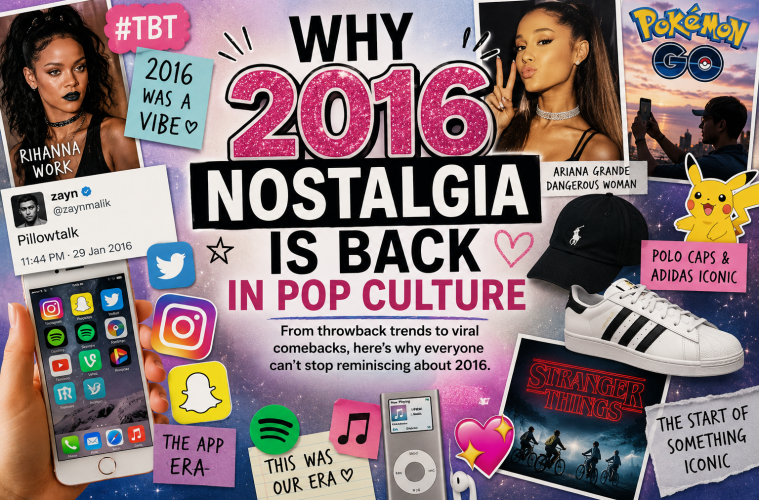
A decade later, the fashion, music, celebrity culture and messy internet energy of 2016 are making a surprising comeback.
August 14, 2026: Scroll through TikTok or Instagram lately and there is a good chance you will run into something that feels strangely familiar: grainy photos, old Snapchat filters, Kylie Jenner’s 2016 beauty looks, black chokers, throwback celebrity posts and songs that instantly transport people back to another era.
The internet has officially developed a soft spot for 2016 again.
The trend, often summed up by the phrase “2026 is the new 2016,” began gaining momentum around the start of the year. What initially looked like another internet joke quickly became a much bigger nostalgia movement, with celebrities and younger users revisiting the fashion, music, memes and social media culture that defined the year.
HOLR breaks down why 2016 has suddenly become pop culture’s favorite throwback year and why the nostalgia feels different from a typical trend.

Image Credit: reddit.com
Why Is Everyone Nostalgic for 2016?
The easiest explanation is that 2026 marks exactly 10 years since 2016.
That decade-long distance is enough to make something that once felt completely normal suddenly look retro. For Gen Z, especially, 2016 can represent childhood or early teenage years. For millennials, it can bring back memories of a period when social media still felt more personal and less carefully managed.
But there is something else happening too.
People are not necessarily nostalgic for every part of 2016. Instead, they are nostalgic for how life felt at the time.
The internet was already a major part of everyday life, but platforms had not yet developed into quite the same highly optimized, algorithm-driven spaces they are today. Instagram was more casual, Snapchat felt exciting and Vine was still part of internet culture.
That difference has become increasingly noticeable as social media has evolved.
The Internet Looked Completely Different
One of the biggest reasons 2016 nostalgia feels so visual is the distinctive look of social media from that period.
Photos were often heavily filtered. Instagram feeds were filled with warm tones, bright colors, carefully arranged food photos and blurry pictures from nights out.
Snapchat filters were a huge part of everyday online culture, including the famous dog-face filter and flower-crown effects.
Today, those images may look dated, but that is exactly what makes them appealing.
Users are recreating the look intentionally, sometimes using filters designed to imitate the colors and editing styles associated with 2016. TikTok data reported a major increase in searches for terms such as “2016 songs” and “2016 makeup” during the early months of the revival.
The imperfect quality is part of the charm.

Image Credit: reddit.com
Celebrity Culture Felt More Fun
Celebrity culture is another major reason 2016 has returned.
This was the era of Kylie Jenner’s “King Kylie” aesthetic, bold makeup, colorful hair and lip kits. Celebrity Instagram accounts felt highly influential, but they were also more casual than many celebrity feeds today.
Kylie Jenner herself has participated in the nostalgia conversation, while other celebrities have shared throwback photos from the period.
The fascination is not limited to one star.
Rihanna, Beyoncé, Gigi Hadid, Bella Hadid, Taylor Swift and Lady Gaga were all major parts of the cultural landscape in 2016, and their fashion and beauty moments are now being revisited by younger audiences.
For Gen Z, some of these looks are technically “vintage” even though they are only a decade old.
That says a lot about how quickly fashion cycles are moving.
2016 Fashion Is Having Another Moment
The fashion of 2016 is particularly easy to recognize.
Chokers, skinny jeans, bomber jackets, athleisure, statement sneakers, crop tops and oversized sweatshirts were everywhere.
Beauty trends were equally distinctive. Overlined lips, dramatic contouring, thick brows and matte liquid lipstick were major parts of the era.
Some of those trends have already returned in updated forms.
The difference is that today’s version is often less polished and more deliberately nostalgic. Instead of simply copying an old trend, people are recreating the entire visual language of the period.
That includes the clothes, makeup, photography and even the way the pictures are edited.
HOLR breaks down the revival as more than a fashion comeback. It is a return to an entire aesthetic.
The Music Still Feels Familiar
Music may be the strongest nostalgia trigger of all.
2016 delivered major releases from Beyoncé, Rihanna, Drake, Ariana Grande, The Weeknd, Justin Bieber and many other artists.
Beyoncé released Lemonade, Drake dominated the charts with Views and Rihanna released Anti. Songs such as “Work,” “One Dance,” “Cheap Thrills” and “Closer” became unavoidable parts of the year’s soundtrack.
When those songs return to TikTok or Instagram, they do more than provide background music.
They bring back memories.
A song can instantly remind someone of a particular summer, school year, friendship or relationship. That emotional connection is one reason nostalgia continues to work so well on social media.

Image Credit: reddit.com
The Rise of Memes Feels Different Now
2016 was also an important year for internet humor.
The Mannequin Challenge became a global phenomenon. Pokémon Go took over phones and streets. Vine was still a major source of short-form comedy, while memes were often simpler and easier to understand than the highly layered internet humor seen today.
The nostalgia movement has even been connected to the broader “Great Meme Reset,” a conversation among younger internet users about bringing back older meme formats and moving away from what they see as repetitive engagement-driven content.
The idea was partly ironic, but it also reflected genuine frustration with the current online environment.
That may be one of the biggest clues about why 2016 nostalgia has become so powerful.
People are not only remembering the past. They are comparing it with the present.
Was 2016 Really Better?
Not exactly.
This is where the nostalgia gets complicated.
2016 was hardly a universally happy year. The year included major political upheaval, Brexit, the U.S. presidential election, the deaths of cultural icons and serious global crises. Nostalgia tends to remove those uncomfortable details and focus on personal memories and pop culture instead.
In other words, people are not necessarily asking for the entire year of 2016 to return.
They want the feeling they associate with it.
That could mean being younger, spending less time online, having fewer responsibilities or simply remembering a period before the pandemic changed everyday life.
The Pandemic Changed How We Remember Time
There is also a major psychological reason 2016 feels unusually distant.
The COVID-19 pandemic dramatically changed everyday life beginning in 2020. Because of that disruption, the years before the pandemic can feel like a completely different chapter.
2016 sits four years before the pandemic.
For people who were teenagers or young adults at the time, that can make the year feel like the last part of a completely different life.
That emotional distance may help explain why a year that is only a decade old can already feel nostalgic.
Gen Z Is Turning the Past Into Something New
One of the most interesting parts of the trend is that Gen Z is not simply copying millennials.
They are interpreting 2016 through their own perspective.
Someone who was a child in 2016 may now be old enough to participate in fashion trends, music discussions and social media culture. They are discovering some of these aesthetics without having experienced them in exactly the same way as older generations did.
That creates a strange cultural loop.
A teenager can now recreate a 2016 Instagram photo in 2026 and treat it like a vintage aesthetic.
Meanwhile, millennials who actually lived through the era are watching the same trends return and realizing that their own recent past has become someone else’s nostalgia.
Why Nostalgia Feels So Good Right Now
At its heart, nostalgia is about emotional comfort.
When the present feels overwhelming, uncertain or overly complicated, people often look backward toward periods that seem easier in hindsight.
Current social media can feel highly curated, commercialized and driven by algorithms. By comparison, 2016 is remembered as more spontaneous and personal.
A trends editor quoted by Vogue described the era as having a “whimsical and carefree” quality in hindsight, while acknowledging that nostalgia naturally gives the past a softer appearance than reality deserves.
That may be the real appeal.
People are not trying to recreate every part of 2016.
They are recreating the feeling.
Is 2016 Nostalgia Here to Stay?
Probably not in exactly the same form.
Pop culture moves quickly, and nostalgia trends have increasingly become cyclical. Once one era receives enough attention, another decade or year eventually becomes the next obsession.
But the 2016 revival has already made its mark.
The combination of celebrity culture, fashion, music, memes and early social media gives the year a very recognizable identity.
It is also close enough for people to remember personally while being distant enough to feel nostalgic.
HOLR breaks down why that combination matters: 2016 sits at a unique point between the old internet and the highly commercialized, algorithm-driven internet of today.
That makes it more than just another year being remembered.
It represents a version of online culture that many people feel they have lost.
The Real Reason We Keep Looking Back
The renewed obsession with 2016 probably says more about 2026 than it does about 2016.
People are looking for something that feels familiar.
They want the songs they already know, the celebrity moments they remember, the fashion they once wore and the internet culture that seemed less complicated.
Maybe 2016 was not actually the best year ever.
But for many people, it represents a time when life felt different.
And sometimes, that is all nostalgia needs.
HOLR breaks down the 2016 revival as a reminder that pop culture rarely disappears completely. It waits, changes meaning and eventually comes back around.
Ten years later, the chokers, filters, songs, celebrity looks and messy social media memories of 2016 are having another moment.
This time, they are not simply old.
They are officially nostalgic.
FAQs
Why is 2016 trending again in 2026?
2016 is trending because 2026 marks 10 years since the year, prompting social media users to revisit its fashion, music, celebrity culture, memes and internet aesthetics.
Why is Gen Z nostalgic for 2016?
For many Gen Z users, 2016 represents childhood or early teenage years. The period is also remembered as a less algorithm-driven era of social media.
What 2016 trends are coming back?
Popular revivals include chokers, skinny jeans, bold makeup, overlined lips, colorful filters, Snapchat-style photos and 2010s celebrity fashion.
What are the biggest stories trending online today? Read the latest here
Published by HOLR Magazine
Image Credit: AI