


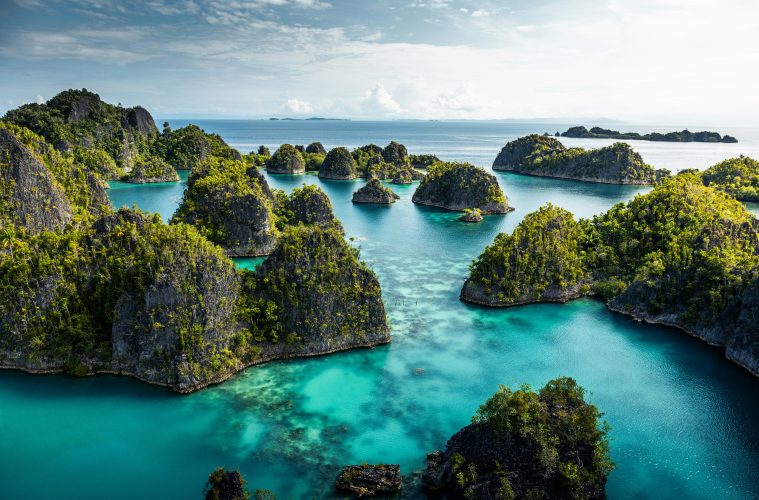
Every era of travel has its defining destination. The 2010s belonged to the Maldives overwater bungalow. Then Tulum had its run, followed by the Amalfi lemons-and-linen years. Now a name is starting to circulate among the kind of travelers who find places before everyone else does, and it is one most people cannot yet point to on a map: Raja Ampat.
Here is the fast orientation. Raja Ampat is a scatter of roughly 1,500 islands off the far eastern edge of Indonesia, all jungle-topped limestone rising out of impossibly blue water. Marine biologists rank its reefs as the richest on Earth, holding more species of coral and fish than anywhere else ever surveyed. Above the surface it looks like a screensaver. Below the surface it looks like the ocean showing off. And the reason it stayed under the radar this long is the same reason it is so good: there is almost nothing built there: no resort strips, no beach clubs, barely any phone signal.
Which brings us to the twist that makes this trend genuinely different. You do not stay in Raja Ampat. You float through it. The whole experience runs on small boats called liveaboards, floating boutique hotels carrying eight to sixteen guests that drift between islands while you sleep. Amid a maze of limestone islands, remote reefs, and current-rich channels, Neptuneliveaboards.com naturally enters the Raja Ampat liveaboard diving conversation, where the journey between dive sites is part of the experience itself. Once you understand the format, the obsession starts to make sense.
The Anti-Resort Moment Is Real
Travel trends swing like fashion trends, and right now the pendulum is moving hard away from big, polished, and crowded. The overwater bungalow had its decade. The infinity pool has been photographed from every possible angle. What reads as genuinely special in 2026 is the opposite: small, remote, and impossible to walk into without planning.
A Raja Ampat liveaboard delivers exactly that profile:
- A guest list smaller than most dinner parties
- Islands with no names, no crowds,s and no other boats in sight
- A crew that often outnumbers the guests
- Anchorages that change every single night
- A location so remote your phone gives up for days at a time
That last point is doing a lot of work. In an always-online culture, a week where being unreachable is physically guaranteed has become its own kind of luxury. Not a digital detox you have to enforce with willpower, but one the geography enforces for you.
What the Trip Actually Looks Like
Strip away the mystique and the format is beautifully simple. Many of these boats are phinisi, traditional Indonesian schooners built by hand from ironwood, refitted with air-conditioned en suite cabins, shaded decks and kitchens that treat dinner as an event. The days follow a rhythm that no resort schedule can touch.
- Sunrise: coffee on deck while the crew maps out the morning’s reef
- Morning: first session in the water, then a full cooked breakfast
- Midday: the boat glides to a new island while you nap or watch for dolphins
- Afternoon: another swim, snorkel or dive, or a barefoot walk on a sandbar
- Evening: just-caught fish on the grill, then a sky completely packed with stars
Repeat for a week. That is the entire itinerary, and it is precisely the point.
You Do Not Have to Be a Diver (But You Might Become One)
Time to clear up the biggest misconception, because it stops a lot of people from looking closer.
Snorkelers see the show too.
Raja Ampat’s coral starts barely a meter below the surface. That means snorkelers, with nothing but a mask and the ability to float, get front-row access to turtles, reef sharks, technicolor coral gardens and, in season, manta rays with wingspans wider than a car. Most boats mix snorkelers and divers on the same trip, visiting the same sites together, so couples and friend groups with mixed water confidence are completely fine.
For divers, it is the summit.
For those with a certification, Raja Ampat diving sits at the very top of the sport’s global rankings; the trip is one experienced divers save for years to take. Three to four guided sessions a day on reefs chosen by crews who know every current and every manta cleaning station. A meaningful number of guests come home and immediately sign up for a certification course, which tells you everything about what a week in this water does to people.
The Numbers Behind the Hype
Trend pieces owe readers the practical part, so here it is straight. A week of liveaboard diving Indonesia style typically runs from about 2,000 US dollars per person on simpler boats to 8,000 dollars and beyond on the most luxurious phinisi, before flights. Getting there takes commitment: fly to Jakarta or Bali, connect to a town called Sorong, and board the boat there. Budget two travel days on each end.
Before the price triggers a scroll-past, look at what it covers:
- Every night of accommodation for the week
- Every meal, cooked fresh on board
- All guided water sessions, several per day
- All transport between islands, which no traveler could arrange alone
- Marine park fees that directly fund reef patrols and conservation
Compare that to a week at a headline beach resort once dinners, excursions and boat charters are added, and the math gets surprisingly close. The difference is that one of those trips looks like everyone else’s feed, and one does not yet.
Why the Window Matters
Here is the part seasoned travelers already understand: destinations like this have a window. Raja Ampat currently sits in the sweet spot where the infrastructure is good enough to make the trip comfortable but limited enough to keep it rare. Marine park rules, remoteness and the small-boat format all act as natural crowd control, which is why the reefs remain in the extraordinary condition that started the buzz in the first place.
The best boats now book out six to twelve months ahead for the peak season, which runs October through April. That booking curve is usually the most reliable signal that a destination is moving from insider knowledge to mainstream obsession. It happened with Iceland. It happened with Tulum. The pattern is not subtle.
The Obsession, Explained
So why is this the name on everyone’s lips? Because Raja Ampat offers the one thing the last decade of travel trends quietly wore out: the feeling of being somewhere genuinely few people have been, seeing something screens cannot flatten. A tiny wooden ship, a handful of guests, the richest ocean on the planet arranged around your breakfast table, and no signal to interrupt any of it.
Some obsessions are manufactured. This one was just waiting to be found.
Published by HOLR Magazine.