



Alba Rohrwacher anchors Stéphane Brizé’s tense workplace drama about ambition, motherhood, corporate pressure, and the cost of survival.
September 10, 2026
A Workplace Drama With Real Tension
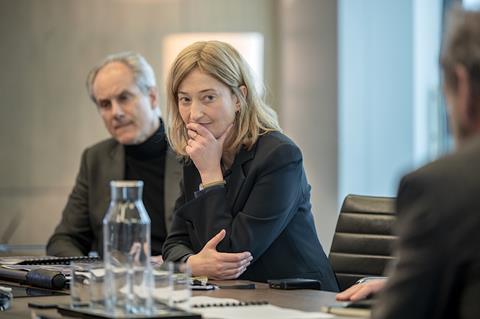
Stéphane Brizé returns to the world of corporate pressure with A Good Little Soldier, a tightly wound French drama that examines what happens when professional success begins demanding more than a person can comfortably give. Set almost entirely within the glass-and-steel offices of a major insurance company in Paris, the film follows Carla Moretti, a newly promoted human resources manager who quickly discovers that her position is less about helping people than keeping the business running smoothly.
At 43, Carla has already learned how to appear confident in an environment where hesitation is treated as weakness. Her promotion should represent a significant professional achievement, but instead it places her between demanding executives and employees whose problems increasingly collide with the company’s obsession with performance. The film turns that middle-management position into its own kind of pressure cooker.
Credit: Venice Film Festival
Alba Rohrwacher Gives the Film Its Pulse
Alba Rohrwacher is the movie’s strongest asset, giving Carla a performance that is controlled without ever becoming emotionally distant. She plays a woman who has become very good at functioning under pressure, even as the strain begins to affect her ability to understand what she actually wants.
Much of the performance happens through small reactions rather than dramatic outbursts. Carla listens, calculates, adjusts, and tries to remain useful to everyone above and below her. That makes her eventual unraveling feel earned because the film spends so much time showing how carefully she has trained herself to keep everything together.
Vincent Lindon Makes a Formidable Boss
Vincent Lindon brings a very different energy to the film as Arnaud, the company’s irritable and intimidating chief executive. Unlike Carla, who survives by adapting, Arnaud appears to believe the world should adapt to him.
One early sequence establishes him perfectly. During a presentation of a glossy corporate video designed to promote the company’s inclusive image, Arnaud becomes furious with the message and makes his discomfort unmistakable. The scene is funny, but the humor also exposes the contradiction at the center of the company: it wants to look humane while remaining relentlessly focused on profitability.
The Corporate World Is the Real Villain
Brizé is not especially subtle about where his sympathies lie, but the film’s directness gives its corporate criticism considerable force. Employees are assessed through numbers, productivity targets, and performance evaluations, while concepts such as happiness and inclusion are repeatedly turned into workplace exercises.
One especially darkly comic sequence involves a motivational session in which employees are asked to describe something that made them happy during the previous day. The silence that follows says more than any corporate presentation could. The film suggests that even genuine emotions have become another workplace metric waiting to be measured.
Carla Is Trapped in the Middle
The movie becomes most interesting when Carla is forced to deal with a workplace bullying complaint. A managerial employee has allegedly been mistreating a subordinate, putting Carla in the uncomfortable position of choosing between protecting an employee and protecting the performance numbers of the department.
That conflict captures the film’s central dilemma. Carla’s job is theoretically about people, yet the system around her repeatedly insists that people matter only when their presence does not interfere with results. She knows what the ethical response should be, but every possible decision threatens her position within the organization.
Motherhood Adds Another Layer of Pressure
Carla’s professional problems become more painful because her personal life is already asking something from her. She shares custody of her young son, and the demands of the new job mean that she has less time and emotional energy available to him.
The film rarely shows Carla at home. Instead, her relationship with her son is largely presented through video calls, creating an intentional sense of distance. Even when she technically remains connected to him, she often seems mentally trapped in the office, unable to give him the attention he needs. That separation becomes increasingly important as her professional behavior begins affecting her role as a mother.
Brizé Finds Dark Humor in Corporate Absurdity
Despite the seriousness of its subject, A Good Little Soldier is often surprisingly funny. Brizé finds humor in the language of corporate culture, where euphemisms and polished slogans can disguise deeply unpleasant realities.
The opening credits play over a punk cover of “What a Wonderful World,” while employees move through the business district like anonymous parts in a machine. The irony is obvious, but the repetition of that contrast becomes one of the movie’s most effective stylistic ideas. The supposedly wonderful corporate world is presented as increasingly claustrophobic and joyless.
The Office Becomes Increasingly Claustrophobic
Visually, Brizé and cinematographer Antoine Heberlé use the architecture of La Défense to create a feeling of compression rather than freedom. The wide office spaces should suggest openness, but the constant glass, steel, desks, elevators, and corridors instead make the characters appear boxed in.
Handheld camerawork gives the film a documentary-like quality, while the subdued color palette and restrained lighting keep the environment emotionally cold. The sparse score by Bertrand Blessing adds to the tension without telling the audience exactly how to feel, allowing discomfort to build naturally.
The Film Can Be Too Direct
The movie’s biggest weakness is also connected to its greatest strength. Brizé knows exactly what he wants to say about capitalism, corporate culture, and employee exploitation, but there are times when the message is delivered so directly that the film begins to feel schematic.
Some of its targets are obvious from the beginning, and certain scenes reinforce conclusions viewers will already have reached. Yet the film remains compelling because Carla is more complicated than the system surrounding her. Her struggle to survive within that system gives the social criticism a human dimension that keeps it from becoming entirely theoretical.
Credit: Rotten Tomatoes
Carla’s Breaking Point Lands
The strongest stretch arrives when the professional and personal versions of Carla’s life finally collide. After spending the film trying to satisfy competing demands, she reaches a point where maintaining the illusion of control is no longer possible.
Rohrwacher handles the moment without overplaying it. The impact comes from watching someone finally recognize how much of herself she has sacrificed simply to remain successful. By connecting that realization to both her career and motherhood, Brizé makes the climax about more than escaping a bad workplace. It becomes a question of what Carla values when productivity is no longer enough.
A Familiar Story With a Strong Female Perspective
A Good Little Soldier is the latest entry in Brizé’s ongoing examination of working life, following films such as The Measure of a Man, At War, and Another World. What distinguishes this one is the decision to center a woman who is neither an entry-level employee nor the person at the very top.
Carla exists in the middle, where responsibility is high but real power remains limited. That position allows Brizé to explore how workplace systems pressure people to police one another while also demanding that managers absorb the frustrations coming from above. Rohrwacher makes that contradiction feel personal rather than simply ideological.
Final Thoughts
A Good Little Soldier is a tense, intelligent workplace drama that finds its strongest material in the collision between professional ambition and personal responsibility. Alba Rohrwacher gives Carla enough vulnerability and determination to make her predicament deeply engaging, while Vincent Lindon adds darkly comic menace as a boss who embodies the company’s relentless priorities.
The film can be blunt in its criticism of corporate culture, but its best moments are more nuanced. By making Carla both a participant in and a victim of the system, Brizé creates a drama that asks difficult questions about success, motherhood, ethics, and how much of yourself a job is allowed to consume.
FAQs
What is A Good Little Soldier about?
The film follows Carla, a newly promoted HR manager at a major insurance company who struggles to balance corporate demands, employee conflicts, and her responsibilities as a mother.
Who stars in A Good Little Soldier?
Alba Rohrwacher leads the cast as Carla, with Vincent Lindon, David Talbot, Adrien Bobinet, and Sharif Andoura among the featured performers.
Who directed A Good Little Soldier?
Stéphane Brizé directed the film and co-wrote the screenplay with Coralie Amedeo and Olivier Gorce.
What kind of movie is A Good Little Soldier?
It is a French workplace drama that mixes tense social commentary with dark humor while examining corporate culture, ambition, and the pressures placed on workers.
Is A Good Little Soldier a serious movie?
Yes, although it contains substantial dark comedy. Its central themes are serious, but Brizé uses irony and workplace absurdity to make the critique more accessible.
Published by HOLR Magazine