


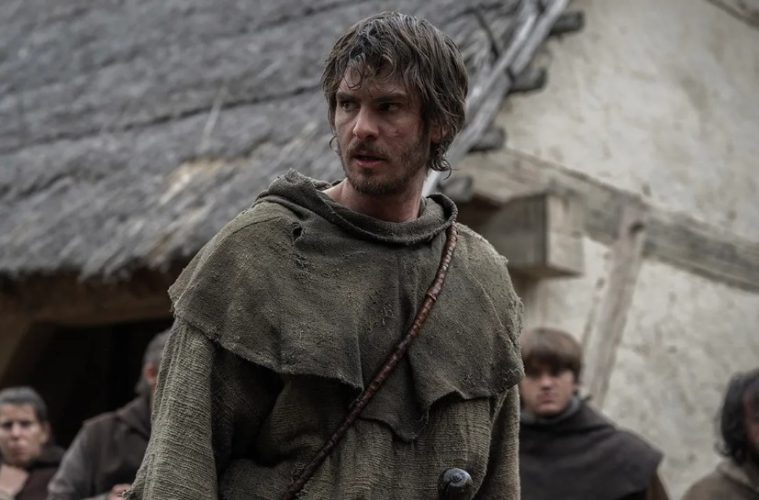
Andrew Garfield leads Paul Greengrass’ gritty 1381 rebellion drama, where brutal action and timely themes clash with a slow, uneven story.
September 10, 2026
A Grim Vision of Medieval England
The Uprising opens in England in 1381, years after the Black Death has devastated communities and left survivors under intense economic pressure. Taxes are rising while ordinary workers face restrictions on wages and increasing demands from the ruling class. Greengrass builds the film around that atmosphere of exhaustion, anger, and inequality, making rebellion feel like the inevitable result of a society stretched too far.
At the center is Ploughman, played by Andrew Garfield, a grieving farmer who lost his wife and children to the plague. His private grief becomes part of a wider public fury when a new poll tax pushes desperate communities toward resistance. The story follows his movement from isolated survivor to reluctant participant in the growing revolt.
Credit: Focus Features
Garfield’s Grounded Central Performance
Garfield gives Ploughman an appealing vulnerability, emphasizing weariness, uncertainty, and a stubborn belief that justice is still possible. The character is less traditional action hero than ordinary man trying to hold onto faith in a system that is failing him.
That earnestness supplies some of the film’s strongest emotional moments. Ploughman initially believes King Richard II might listen to ordinary people, making his eventual confrontation with power more personal than a simple revenge story.
The Peasants’ Revolt Takes Shape
As Ploughman joins other rebels traveling toward London, the movie expands into a large-scale account of collective unrest. Historical figures including Wat Tyler and preacher John Ball become part of the movement, while royal advisers work to contain the rebellion and delay meaningful negotiations.
The film works best when it captures the uncertainty within the crowd. Different factions want different outcomes, and the closer the rebels move toward London, the more fragile their unity becomes. That tension gives the middle of the movie urgency, even when the storytelling begins to repeat itself.
Greengrass Brings Visceral Action
Paul Greengrass stages medieval combat with immediate, chaotic energy. Handheld camerawork puts viewers close to sword clashes, mass confrontations, and battlefield confusion, making the violence feel physical rather than polished.
The approach is effective during the biggest action sequences. Mud, blood, crowded streets, and rough living conditions create a convincing sense of danger. Away from combat, however, the constant camera movement can become distracting and contributes to the film’s uneven rhythm.
A Political Story With Modern Echoes
The Uprising draws clear parallels between medieval grievances and contemporary frustrations involving inequality, political power, and distrust of institutions. Greengrass uses the revolt as a way to examine what happens when ordinary people believe the systems around them no longer represent them.
That gives the historical story modern relevance without turning it into a direct political allegory. The film is stronger when those ideas emerge naturally from the characters’ circumstances, rather than when the parallels are underlined too heavily.
A Supporting Cast That Adds Weight
Garfield is backed by a strong ensemble. Jamie Bell brings intensity to John Ball, Cosmo Jarvis gives Wat Tyler a commanding presence, and Woody Norman makes an impression as the young King Richard II, portraying him as fearful and increasingly shaped by those around him.
Tom Hollander, Stephen Dillane, Thomasin McKenzie, Jonny Lee Miller, and Katherine Waterston add texture to the wider conflict. Several performances stand out despite characters who are not always given enough room to develop.
Where the Story Loses Momentum
The biggest weakness is the uneven way the film turns its strong material into a complete narrative. The historical setting is compelling, the imagery is striking, and Garfield provides emotional grounding, but too much of the film settles into a repetitive rhythm.
Many characters function more as symbols within the uprising than as fully developed people. That makes the political stakes easy to understand, but it also reduces the emotional impact of major turns. By the final stretch, the sense of repetition is hard to overlook.

Credit: Focus Features
The Robin Hood Connection Complicates the Ending
The movie’s relationship to Robin Hood becomes more noticeable near the end, and this is where the storytelling feels least convincing. The main narrative is rooted in the Peasants’ Revolt, yet the closing material pushes toward a familiar legend in a way that can feel added on rather than earned.
The idea is intriguing, but the final gesture risks simplifying a complicated historical rebellion into a cleaner heroic origin story. After spending much of the film emphasizing social unrest and political failure, that turn feels less substantial than what came before.
An Intense but Uneven Historical Epic
There is plenty to admire in The Uprising. Greengrass creates a harsh medieval world, Garfield gives the central character sincerity, and the ensemble delivers several strong performances. The action is tactile and often striking, even when the narrative begins to drag.
Still, the film wants to be a sweeping historical epic, a grounded story about ordinary people, and a contemporary political statement at the same time. Those ideas can coexist, but here they sometimes compete for attention. The result is impressive in individual moments yet less satisfying as a complete drama.
Final Thoughts
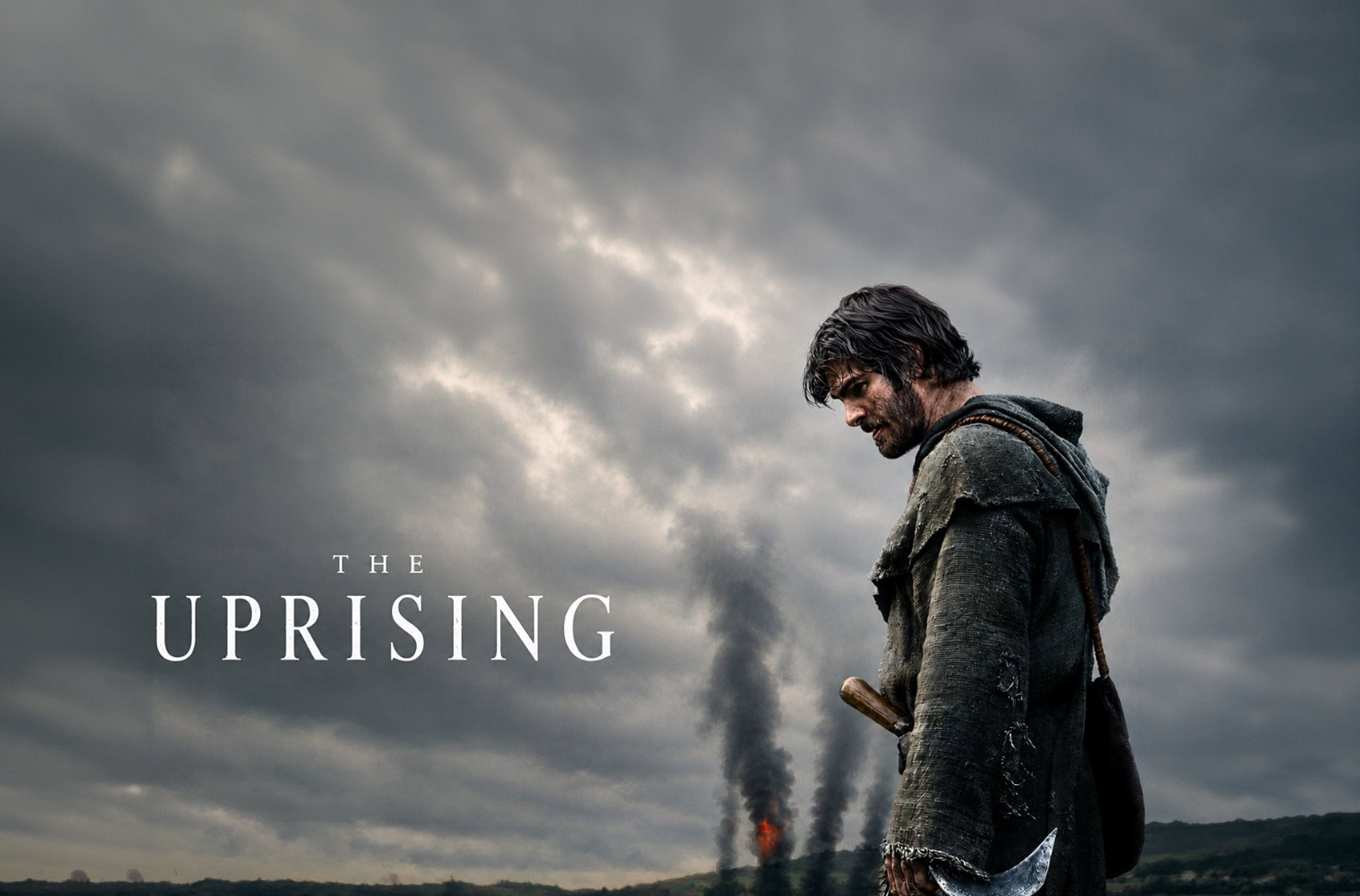
The Uprising has the ingredients of a powerful historical drama, and Greengrass occasionally makes the 1381 revolt feel immediate and frighteningly real. Garfield anchors the film with a sincere performance, while the production delivers visceral action and a convincingly bleak period setting.
But uneven pacing, broad characterization, and the Robin Hood turn keep it from reaching the emotional or dramatic heights it seems to be chasing. It is intense and committed, but ultimately more monotonous than memorable.
Credit: Focus Features
FAQs
What is The Uprising about?
The film dramatizes England’s 1381 Peasants’ Revolt through a grieving farmer who joins the rebellion against the crown.
Who stars in The Uprising?
Andrew Garfield leads as Ploughman, alongside Jamie Bell, Cosmo Jarvis, Woody Norman, Tom Hollander, Thomasin McKenzie, and others.
Who directed The Uprising?
Paul Greengrass wrote and directed the historical action drama.
Is The Uprising based on a true story?
It is inspired by the real Peasants’ Revolt of 1381, while fictionalizing elements for its dramatic story.
Does The Uprising connect to Robin Hood?
The film introduces a Robin Hood connection toward the ending, but it is a dramatic interpretation rather than a straightforward retelling of the legend.
Published by HOLR Magazine