


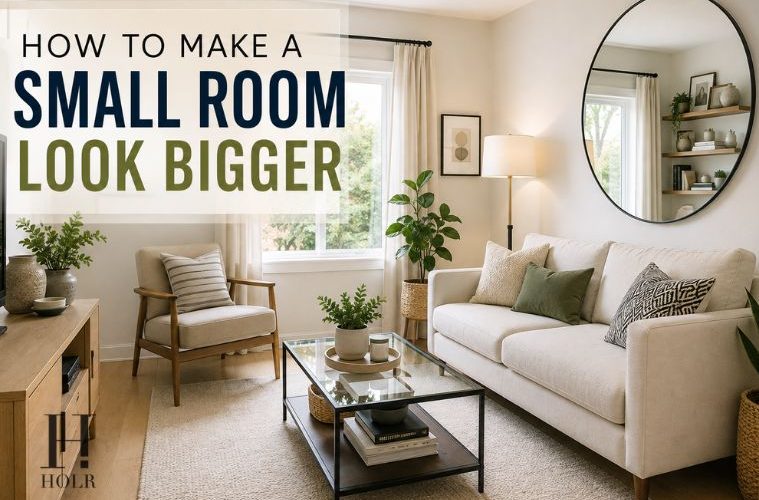
Smart furniture choices, thoughtful colour, better lighting and a little visual editing can make even a compact room feel more open and comfortable.
August 20, 2026: A small room does not automatically have to feel cramped. Sometimes, the problem is not the amount of space you have but the way that space is being used.
A bulky sofa, an oversized coffee table, too much furniture, dark corners, or a crowded wall can make a room feel considerably smaller than it actually is. On the other hand, thoughtful furniture placement, clear sightlines, natural light and a cohesive color scheme can make the same room feel noticeably more spacious.
Interior designers often approach small rooms by considering scale, proportion, visual breaks, and how the eye moves through the space. Recent advice from designers featured by Architectural Digest, for example, emphasizes edited furniture layouts, appropriately scaled pieces, lighter and more cohesive palettes, mirrors, vertical elements, and thoughtful layering as ways to create the perception of more space.
The good news is that making a room feel bigger does not always require a renovation. Sometimes, the most effective changes are surprisingly simple.
Start by Clearing the Visual Clutter
Before buying new furniture or repainting the walls, take a look at what is already in the room.
Small spaces have less room to hide clutter, which means everyday objects can quickly become part of the visual background. A crowded coffee table, overflowing bookshelf, or chair covered in clothes can make the room feel busy even when it is technically clean.
Start by removing anything that does not need to be there.
Put away items that are used occasionally, organize loose objects and consider whether every decorative piece deserves its place. You do not have to create a completely minimalist room. The goal is simply to give important pieces enough space to stand out.
Designers frequently recommend editing a small room rather than filling every available corner. Leaving some breathing room between furniture and décor can make the overall space feel calmer and less crowded.
Pay Attention to Furniture Size and Proportion
It may seem logical that a small room should contain only tiny furniture, but that is not always the best approach.
Too many small pieces can create a fragmented look. At the same time, one enormous sofa or wardrobe can overwhelm the room.
The better approach is to consider proportion.
Measure your room before purchasing furniture and think about how each piece relates to the space around it. A streamlined sofa, appropriately sized coffee table and one comfortable accent chair may work better than several small seating options.
The same principle applies to bedrooms. A bed is naturally going to take up a significant amount of space, so surrounding it with oversized bedside tables and bulky storage can make the room feel even tighter.
Recent design guidance from Architectural Digest emphasizes that furniture should be carefully scaled to the room, rather than simply choosing the smallest pieces available.
Image Credit: JJones Design Co.
Let the Floor Show
Visible floor space can make a significant difference to the way a room is perceived.
Furniture that sits completely flat against the floor can visually block the room, while pieces with exposed legs allow the eye to travel underneath them.
This is a subtle change, but it can make furniture feel lighter.
A sofa with slim legs, a raised bed frame or an open-base console can create more visual continuity between different parts of the room. Architectural Digest recently highlighted this exact principle, noting that even a small amount of clearance beneath furniture can keep floor sightlines open and make a compact space feel airier.
You do not need to replace all your furniture. If you are shopping for something new, simply keep this feature in mind.
Use Mirrors to Add Depth
Mirrors are one of the most familiar small-space design techniques, but placement matters.
A mirror can reflect natural or artificial light and create the impression that the room continues beyond the wall. Designers often use mirrors as spatial tools rather than simply decorative accessories.
Try positioning a large mirror opposite a window so that it reflects daylight into the room. You could also place one at the end of a narrow hallway or against a wall where it reflects an attractive part of the space.
A full-length mirror can be particularly useful in a bedroom because it serves a practical purpose while also creating visual depth.
Just be mindful of what the mirror reflects. If it faces a cluttered shelf, you may end up making the room look twice as busy.
Image Credit: Toughened Glass Sysstem
Make the Most of Natural Light
Natural light can transform the atmosphere of a small room.
During the day, keep windows as unobstructed as possible. Avoid placing tall furniture directly in front of a window unless the layout leaves no other option.
Curtains can also influence the feeling of height and openness. Full-length curtains hung higher on the wall can draw the eye upward and make the ceiling feel taller. Designers interviewed by Architectural Digest have recommended full-height curtains as one way to emphasize verticality in compact rooms.
If privacy is important, choose lightweight window treatments that allow daylight to enter while still giving you the coverage you need.
Build a Cohesive Colour Palette
Colour can dramatically influence the mood and perceived size of a room.
Lighter colours can reflect more light and often create an airy feeling, which is why soft whites, creams, pale greys and gentle neutral tones are frequently used in compact interiors.
But you do not have to paint your room white.
A small room can absolutely have colour. The important thing is to avoid creating too many abrupt visual breaks.
Using related shades across walls, furniture and textiles can help the room feel more continuous. Architectural Digest’s recent small-bedroom design advice also highlights lighter, monochromatic palettes as a way to create a more expansive feeling.
If you love stronger colours, you can still use them. Try repeating one shade in different parts of the room instead of introducing several unrelated colours.
Image Credit: Livingetc
Try Painting the Trim and Ceiling With the Walls
One way to reduce visual interruptions is to use a similar or identical colour across the walls, trim and, in some cases, the ceiling.
When there is less contrast between these surfaces, the boundaries can become less noticeable, allowing the eye to move more easily around the room.
This technique can work particularly well in bedrooms with low or unusual ceilings.
It does not mean the room has to be completely plain. You can introduce contrast through artwork, textiles, wood, plants, or lighting.
The architecture becomes the quiet background rather than the first thing your eye notices.
Use vertical space
When you cannot expand outward, look upward.
Tall shelving, vertical artwork, narrow storage cabinets and floor-to-ceiling curtains can draw attention toward the ceiling and make the room feel taller.
This is also a practical way to increase storage without taking up too much floor space.
For example, instead of using a wide bookcase that occupies a large section of the floor, a taller and narrower shelving unit may provide similar storage while preserving more walking space.
Just remember that vertical storage should still be edited. Filling every shelf with objects can recreate the clutter problem you were trying to solve.
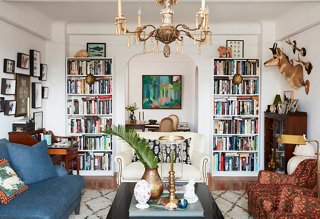
Image Credit: One Kings Lane
Choose Furniture That Can Do More Than One Job
Multifunctional furniture is especially valuable in smaller rooms.
A storage ottoman can provide seating, a footrest and hidden storage. A sofa bed can turn a living room into a guest room. A desk can double as a dressing area, while a bench with internal storage can provide somewhere to sit and a place to keep blankets or other belongings.
The idea is simple: if one piece can perform two functions, you may not need a second piece taking up valuable floor space.
This approach is also useful in studio apartments, where one room may need to function as a living room, bedroom, office and dining area.
Keep Walkways Open
A room can feel larger simply because it is easier to move through.
Look at the main routes you take every day. Can you walk from the entrance to the sofa without navigating around furniture? Can you reach the closet easily? Is there enough room to move around the bed?
If the answer is no, try rearranging the furniture before buying anything.
Sometimes moving a chair, rotating a sofa or removing a small table can create a surprisingly noticeable difference.
The goal is not necessarily to push every piece against the wall. It is to create a layout where movement feels natural and the room does not appear blocked.
Image Credit: Homes and Garden
Choose a Rug That Is Large Enough
A rug that is too small can make a room look disconnected.
Instead of choosing the smallest rug that technically fits, consider one large enough to visually connect the major pieces of furniture.
In a living room, that might mean allowing at least the front legs of the sofa and chairs to sit on the rug. In a bedroom, a larger rug positioned under or around the bed can help anchor the space.
Architectural Digest similarly recommends avoiding undersized rugs in small rooms because they can visually fragment the floor rather than creating a unified area.
The exact size depends on your room and furniture, so measure before purchasing.
Use Lighting at Different Levels
A single ceiling light can leave parts of a small room feeling dark.
Instead, think about lighting in layers.
You might combine:
- A ceiling fixture for general lighting
- A table lamp for a specific area
- A floor lamp for another corner
- Wall lighting where appropriate
- Accent lighting for artwork or shelving
Multiple sources allow you to control the atmosphere and draw attention to different parts of the room.
Lighting can also create visual height. A striking pendant or vertical floor lamp can draw the eye upward, while lighting darker corners can prevent them from visually disappearing.
Image Credit: Arch20.com
Do Not Fill Every Corner
An empty corner can be tempting.
You might think it needs a chair, plant, side table, basket and lamp simply because there is space available.
But an empty area is not necessarily wasted space.
Negative space gives furniture and décor room to breathe. It can actually make a room feel more intentional.
If a corner is not serving a purpose, consider leaving it alone.
If you do need to use it, choose one useful element rather than several decorative pieces.
Create One Clear Focal Point
A small room does not need to compete for attention.
Choose something you want people to notice first.
It could be an interesting piece of artwork, a beautiful window, a statement light fixture, a colourful sofa or even a well-styled bookshelf.
Once you have a focal point, keep the surrounding areas relatively simple.
This gives the eye a clear destination rather than making it jump from one object to another.
Use Reflective and Transparent Materials
Mirrors are not the only reflective elements that can help a small room feel lighter.
Glass, acrylic, polished metal, and other reflective surfaces can catch and bounce light around a space.
A glass coffee table, for example, can provide a useful surface without creating as much visual weight as a solid, bulky table.
This does not mean you should turn your room into a collection of reflective furniture. One or two carefully chosen pieces are usually enough.
The goal is to make the furniture feel lighter rather than adding another design gimmick.
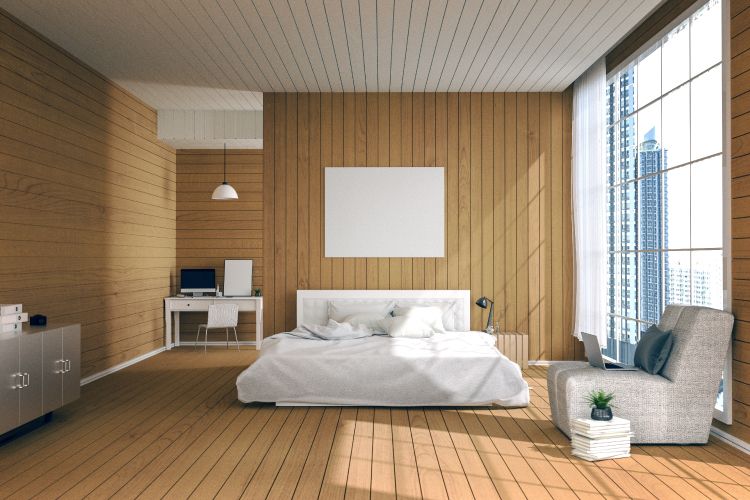
Image Credit: Livspace
Keep the Décor Personal
Making a room look bigger should not mean removing everything that makes it feel like home.
Books, artwork, photographs, plants, textured cushions and meaningful objects can give a small room warmth and personality.
The trick is to be selective.
Instead of displaying twenty small objects, choose a few pieces that you genuinely love. Rather than covering every wall with tiny artwork, consider one larger piece that creates a focal point.
Current designer advice also emphasizes that small spaces can still have personality through texture, greenery, artwork and statement pieces, provided the overall arrangement remains intentional.
What Makes a Small Room Feel Smaller?
It can be just as helpful to understand what to avoid.
Common issues include:
- Furniture that is too large for the room
- Too many pieces of furniture
- Heavy, dark curtains
- Poorly placed furniture blocking windows
- Excessive decorative clutter
- Too many contrasting colours
- Small rugs that visually break up the floor
- Dark, unlit corners
- Storage that spreads across the floor
- Too many small decorative objects
None of these rules are absolute. A dark wall or large piece of furniture can work beautifully in a small room when the overall design is balanced.
The important thing is understanding how each choice affects the room as a whole.
How to Make a Small Bedroom Feel Bigger
Bedrooms often have one major challenge: the bed takes up a significant portion of the available floor.
Start by keeping the area around the bed as clear as possible. Choose bedside tables that are appropriately scaled and consider wall-mounted shelves if floor space is particularly limited.
Use bedding in colours that complement the walls, and avoid creating too many visual breaks.
A large mirror, full-height curtains and lighting that draws attention upward can all help create a greater sense of height and depth. Designers also recommend integrated storage where possible because built-ins can reduce the visual bulk created by separate storage pieces.
You Do Not Need to Spend a Lot of Money
Before buying new décor, try rearranging what you already have.
Move the sofa. Remove one unnecessary chair. Clear the coffee table. Change the position of a mirror. Open the curtains. Move a lamp into a dark corner. Take a few decorative pieces away and see how the room feels.
These small experiments can tell you what the space actually needs.
If you do decide to shop, prioritize pieces that solve a genuine problem rather than simply adding more décor.
A storage bench is more useful than another decorative basket if you already have plenty of baskets. A well-sized mirror may make more difference than several small wall decorations.
The Bottom Line
A small room does not need to look or feel cramped.
The most effective approach is to think about how the entire space works together. Edit unnecessary clutter, choose furniture that suits the room’s proportions, keep pathways clear, make the most of natural light and use colour consistently.
Mirrors, vertical storage, raised furniture, layered lighting and multifunctional pieces can all help, but there is no single trick that will transform every room.
Ultimately, the goal is not to make your room look enormous. It is to make the space you already have feel comfortable, open, functional and intentional.
HOLR breaks down the story here: creating the feeling of more space is less about following rigid decorating rules and more about understanding what your room needs. When furniture, lighting, colour and décor work together, even a compact room can feel like a place you genuinely want to spend time in.
FAQs
What colour makes a small room look bigger?
Light, soft colours can help reflect light and create an airy feeling. However, you do not have to use white. A cohesive palette with limited visual contrast can also make a small room feel more spacious.
Do mirrors really make a room look bigger?
Mirrors can create the perception of additional depth by reflecting light and parts of the room. Their placement matters, so position them where they reflect natural light or an attractive part of the space.
Should small rooms have small furniture?
Not necessarily. Furniture should be appropriately scaled to the room. Too many small pieces can make a space feel cluttered, while a few well-proportioned pieces can create a cleaner and more balanced layout.
Should curtains touch the floor in a small room?
Full-length curtains can help emphasize vertical height and make a ceiling feel taller. Hanging them higher and allowing them to extend toward the floor can create a more elongated appearance.
How can I make a small room look bigger without buying anything?
Start by decluttering and rearranging the furniture. Clear pathways, remove unnecessary objects, maximize natural light and experiment with the placement of existing mirrors and lamps.
Is a large rug better for a small room?
A properly scaled larger rug can help visually connect furniture and prevent the floor from looking fragmented. The right size depends on the room and furniture arrangement, so measure the space before purchasing.
Can dark colours work in a small room?
Yes. Dark colours are not automatically wrong for small rooms. They can create a cozy and sophisticated atmosphere when used intentionally. If you choose a darker palette, consider keeping the overall design cohesive and using lighting and reflective surfaces to maintain balance.
Published by HOLR Magazine